As a gamer who has followed PlayStation's first-party output for more than a decade, I still find the $19.99 price tag attached to Horizon Forbidden West: Burning Shores to be one of the smartest moves Sony and Guerrilla Games made in recent years. When the expansion was announced for an April 19, 2023 launch, the industry was locked in a heated discussion about rising software costs, with The Legend of Zelda: Tears of the Kingdom becoming a flagship example of the new $70 standard. Adjusted for inflation, games have always been pricey, but that does not make the sting of a premium launch any easier. Against that backdrop, Burning Shores arrived as a clear statement: a full-scale, story-driven open-world expansion could still be offered for less than the cost of a takeout dinner. Now that we are in 2026, and many publishers are pushing $30 or even $40 season passes and piecemeal content drops, that $19.99 feels almost nostalgic—and very fair.
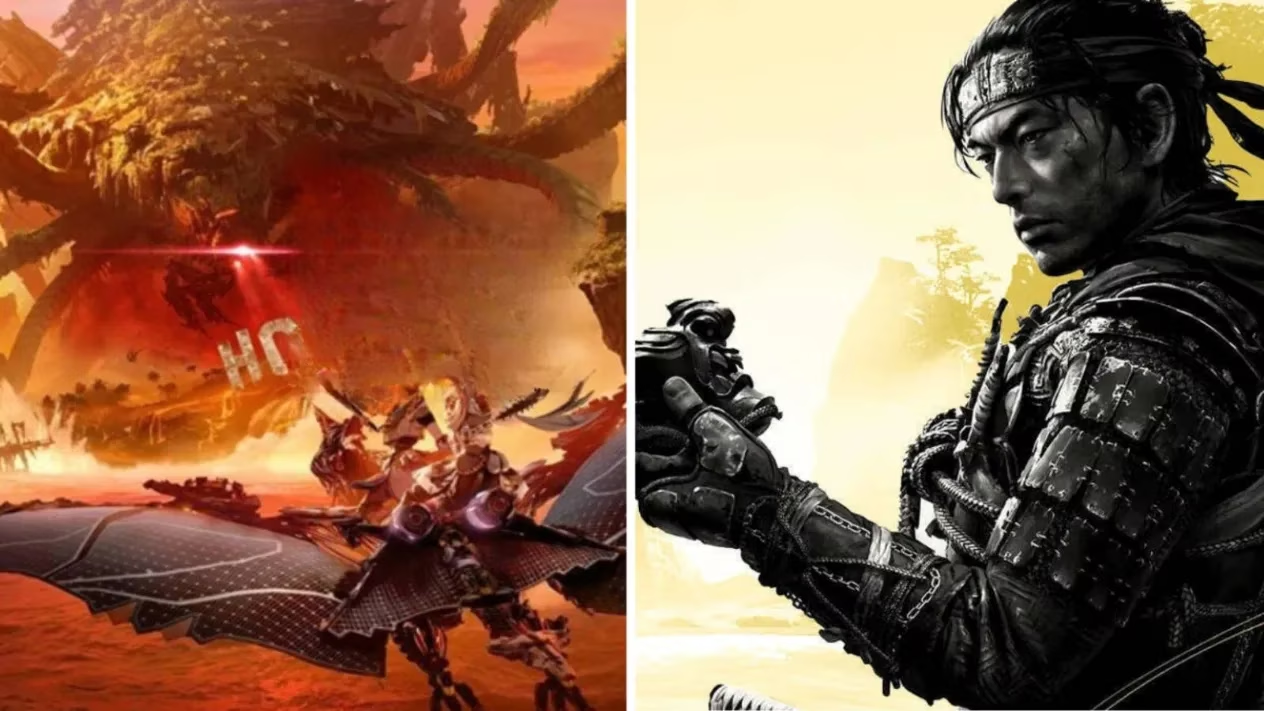
A Pricing Precedent Built on Goodwill
Sony's first-party library has been the main reason many players, including myself, keep coming back to PlayStation hardware. From Marvel's Spider-Man and God of War to Ratchet & Clank and the Horizon series, these exclusives define the platform's identity. Yet, historically, Sony has not pushed its internal studios to flood the market with paid expansions. God of War, Ratchet & Clank, and even the wildly successful Uncharted franchise never received paid story DLC, even though fans would have happily paid for more. When PlayStation Studios did dip into paid add-ons, the pricing was usually restrained. That restraint is exactly what made Ghost of Tsushima's Iki Island expansion so memorable, and it laid the groundwork for Burning Shores.
Ghost of Tsushima Proved the $19.99 Formula
Sucker Punch's Ghost of Tsushima launched in the middle of a crowded July 2020 window, almost directly opposite The Last of Us Part 2, and still managed to be a massive success. It sold just under 10 million copies in two years—a remarkable number for a brand-new IP, even if it did not match the juggernaut pace of God of War Ragnarok. When the time came for Ghost of Tsushima to receive its expansion, Sony kept the price at $19.99. For that money, players got Iki Island, a dense new location packed with side activities, collectibles, and a new five-hour single-player campaign. The full package often stretched beyond 12 hours of content. I remember exploring Iki Island and feeling that I had received more value than I had from some full-priced games. That experience set an expectation in my mind: $19.99 can mean a real expansion, not just a couple of cosmetics or a short bonus mission.
Burning Shores Follows the Same Blueprint
When Sony and Guerrilla Games officially announced Horizon Forbidden West: Burning Shores at that $19.99 / £15.99 price point, I felt a mix of relief and excitement. The base game, Horizon Forbidden West, was already one of the most visually stunning open-world titles on PS5, and the idea of a new region built around a post-apocalyptic, volcanic Los Angeles—complete with an overgrown Hollywood sign—was genuinely thrilling. The expansion was scheduled to launch on April 19, 2023, exclusively for PS5, even though the base game was available on both PS4 and PS5. That PS5 exclusivity allowed Guerrilla Games to push the hardware further, something I appreciated as a player who had already upgraded.
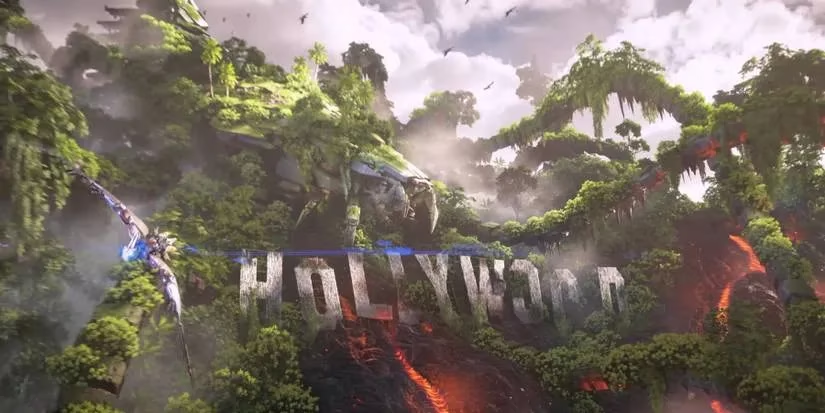
The content itself was designed to feel like a proper continuation of Aloy's journey, rather than a throwaway side story. While the Burning Shores map was not as large as the base game's sprawling frontier, it was dense, atmospheric, and filled with new machines and environmental storytelling. I spent far more time in those sun-scorched ruins and coastal cliffs than I had expected. In a market where some publishers lock story conclusions behind multiple season passes, getting a complete new chapter for $19.99 was a refreshing change.
What This Means for Players in 2026
Looking back from 2026, the $19.99 pricing model for first-party PlayStation expansions feels like a benchmark that more publishers should study. The current landscape is full of premium editions, battle passes, and early access incentives that can push the true cost of a single game well beyond $100. In that context, a straightforward $19.99 expansion with a new campaign, new open-world location, and meaningful amount of side content is practically a bargain. It also reinforces trust: when players know a first-party expansion will be fairly priced, they are more likely to invest in the base game and the platform ecosystem.
To be clear, I am not saying every expansion should cost $19.99. Budgets vary, and some DLC projects are genuinely large enough to justify a higher price. But the consistency between Ghost of Tsushima's Iki Island and Horizon Forbidden West: Burning Shores suggests a philosophy that values long-term goodwill over short-term extraction. That is something I, as a player, deeply respect.
A Simple Comparison
Here is a quick look at what each expansion delivered at the $19.99 price point:
| Expansion | Developer | Price | New Campaign | New Open-World Location |
|---|---|---|---|---|
| Ghost of Tsushima: Iki Island | Sucker Punch | $19.99 | ~5-hour story, 12+ hours total | Iki Island |
| Horizon Forbidden West: Burning Shores | Guerrilla Games | $19.99 | Substantial new story chapter | Volcanic Los Angeles archipelago |
Final Thoughts
As 2026 rolls on, I hope Sony keeps this approach alive. Rumors continue to swirl about future PlayStation Studios projects, and if the Burning Shores model is any indication, there is a real appetite for fairly priced, content-rich expansions. The industry has enough monetization controversy; it is genuinely nice to point to a pair of first-party DLC releases that got the value equation right. For anyone who skipped Burning Shores back in 2023 because they were wary of DLC pricing, I can only say this: it was worth every dollar, and it remains one of the better values I have purchased this generation.