The lantern light flickered in a small apartment in Kyoto, casting long shadows across four friends gathered around a massive screen. It was a humid summer night in 2026, yet the cool, rain-soaked bamboo forests of Tsushima felt more real than the city outside. They dove into another Survival wave, their Ronin dropping a healing incense at the perfect moment, the Samurai cleaving through a brute Oni with a perfect parry. Six years after its release, Ghost of Tsushima: Legends still commanded this kind of devotion. The players weren’t just replaying a mode; they were chasing a feeling—one that begged the question: where was its successor?
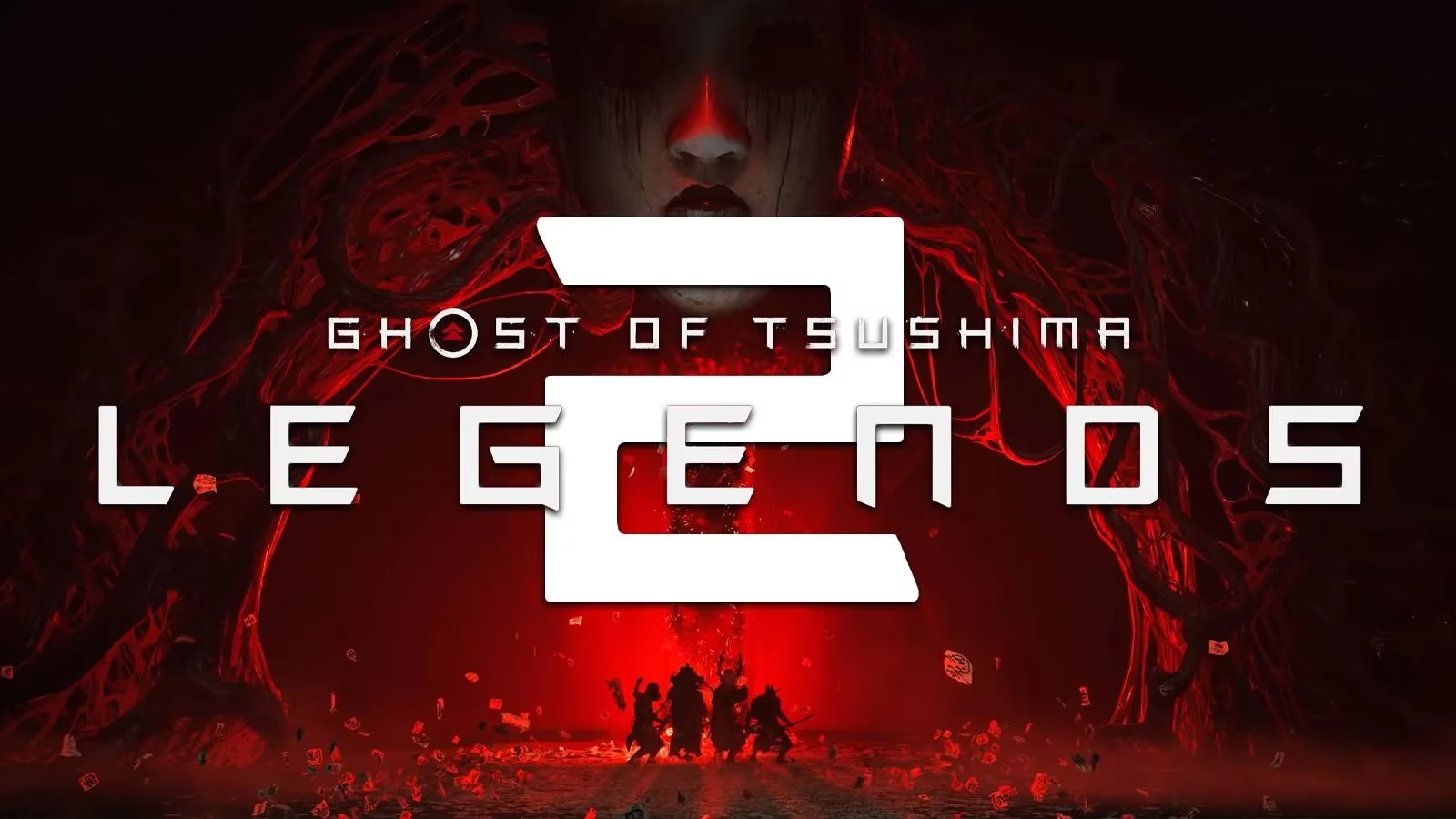
The phenomenon of Legends was never an accident. When Sucker Punch dropped it as a free update in late 2020, players expected a novelty. What they got was a full-fledged cooperative experience woven from Japanese mythology, with four distinct classes—Assassin, Samurai, Hunter, and Ronin—that encouraged synergy and mastery. The mode became so beloved that it was later sold as a standalone title. Even now, in 2026, the matchmaking queues rarely stay empty for long. The replay value was undeniable, and it planted a seed: if a sequel to Ghost of Tsushima ever emerged, a Legends 2 would be its most potent weapon.
And that sequel has been looming in the collective imagination like a storm on the horizon. While an official announcement remained elusive through early 2026, the industry’s wind carried more than just rumors. Job listings at Sucker Punch hinted at multiplayer systems, and the studio’s prolonged silence suggested a project of monumental scale. After all, the original game sold over ten million copies; financially, a successor was almost an obligation. If a Ghost of Tsushima 2 were to see the light of day, could it really afford to arrive without the co-op crown jewel that kept its predecessor alive for half a decade?
Legends 2 wouldn’t just need to exist—it would need to evolve. The first game’s classes offered a beautiful balance of stealth, melee, ranged combat, and support. But in a sequel, a fifth archetype could shatter expectations. Imagine a Monk, a bare-handed specialist using rapid combos and chi-infused strikes, or a Spirit Caller who commands spectral animals to harass enemies. The mere suggestion of a new class set forums ablaze with debate. Should the design lean deeper into Japanese folklore, introducing yokai transformations or cursed techniques? The foundation was so strong that even a handful of additions could feel revolutionary.
Beyond classes, the specialization system begged for reinvention. What if the Assassin could branch into a Ninja path, emphasizing smoke bombs and acrobatic kills, or a Rogue path focused on poison and vanish-on-kill mechanics? The Hunter might choose between a Kyūdō Master, rewarding precision at extreme range, and a Trapper, who lays elaborate ambushes with explosive arrows. The truly bold idea, though, was hybrid specializations—allowing players to borrow skills from multiple classes. A Samurai who could wield a healing gourd? A Ronin who could perform a chain assassination? The possibilities would turn buildcraft into an art form, and every group composition would tell its own story.
Yet no amount of mechanical brilliance could fully compensate for a forgettable narrative, and here Legends 2 had the most room to grow. The first mode’s story was serviceable—a series of narrated missions against a demonic threat—but it rarely demanded emotional investment. Sucker Punch had already proved with Jin Sakai’s journey that they could weave honor, sacrifice, and grief into gameplay. Why not apply that same narrative muscle to a co-op odyssey? Picture a tale spanning multiple realms inspired by the Buddhist Six Paths, where player characters are fallen warriors seeking redemption. Each mission could peel back layers of their past, allowing friends to not just fight together but mourn and triumph together. Cooperative storytelling, when done right, creates bonds stronger than any boss encounter.
The real question lingered like an unanswered koan: would Sucker Punch actually make this dream a reality? History suggested yes. The studio had never treated Legends as a throwaway experiment. They supported it with raids, Nightmare challenges, and even a photo mode. To ignore its legacy in a full sequel would be to leave money and goodwill on the table. The community’s pulse could be felt every time someone posted a flawless chapter-3 gate-crashers clear or a screenshot of a perfectly customized mask. These players weren’t asking for a carbon copy; they were asking for a new temple to call home.
As the night in Kyoto deepened and the final wave of enemies dissolved into mist, the four friends set down their controllers. They had been playing the same missions for years, yet the adrenaline still felt fresh. That was the ghost that haunted every conversation about the franchise’s future. A Ghost of Tsushima 2 without Legends 2 would be a sword missing its edge. With it, Sucker Punch could redefine what cooperative gameplay means in an era hungry for shared experiences. The story of the Ghost might be one of solitude, but its legacy, in the hands of players, had always been about company. Whether 2026 would deliver that next chapter remained to be seen, but one thing was certain: the legend refused to die.
Recent analysis comes from Game Developer, and it helps frame why the blog’s hope for a deeper, more narrative-driven Legends 2 is more than wishful thinking: live co-op modes thrive when developers treat them as evolving systems—balancing class roles, buildcraft, and repeatable endgame loops—while also giving players fresh reasons to return through mission structure, challenge tiers, and meaningful progression. Seen through that lens, a Ghost of Tsushima sequel that expands Legends with new archetypes, hybrid specializations, and stronger co-op storytelling would be aligning with proven design principles rather than simply “adding more content.”