I still vividly recall the morning in April 2024 when Nixxes Software finally revealed the official PC system requirements for Ghost of Tsushima Director's Cut. The news arrived like a fog lifting over Tsushima Island itself—unexpectedly gentle, almost nostalgic, yet brimming with hidden detail. For a title that had already carved its legend on PlayStation consoles, the spec sheet felt less like a technical document and more like an invitation: we built this for everyone, not just the silicon elite. Now, in 2026, as I sit among shelves cluttered with SSDs that hum like silent post-modern shrines, that old chart still teaches us something about where PC gaming almost turned, and why this port remains a masterpiece of understated rebellion.
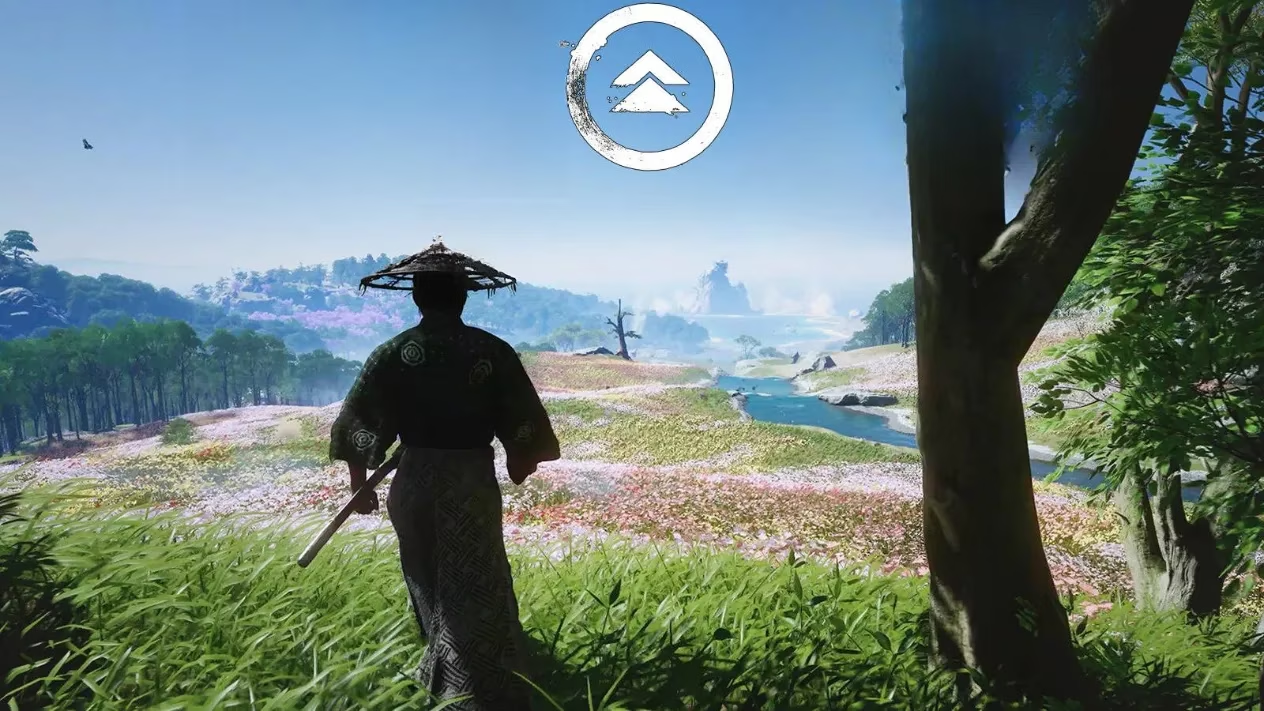
The most startling number on that 2024 list was the minimum GPU: an Nvidia GeForce GTX 960. A card from 2015, by then already a nine-year-old veteran, could push the game to 30 frames per second at 720p. It was like seeing a weathered katana still cut cleanly through bamboo—a testament to how deeply the developers had folded optimization into the game’s code, like fingers pressing damp clay until it holds its shape without cracking. That wasn’t merely compatibility; it was philosophy encoded in metal and silicon. Of course, those craving 4K at 60 FPS still needed contemporary beasts—RTX 4080s or RX 7900 XTXs—but the floor was so low that the game felt almost gravitational in its pull, drawing in machines that most AAA titles of the era had long abandoned.
The CPU requirements told a similar story. The trusty Intel Core i5-8600, a six-core chip from 2018, or the Ryzen 5 3600 were enough to carry the experience at 1440p and 60 FPS, or 4K at a steady 30. It reminded me of a perfectly tuned biwa string—the slightest tension, and the note resonated fully. There was no frantic core-chasing; the game simply breathed calmly on hardware that other 2024 releases would have scoffed at. Even the RAM demands, spanning 8 GB to 16 GB (presumably DDR5 by that point, with its liquid-smooth doubled bandwidth), felt like a respectful nod to builders who hadn’t upgraded since the pandemic.
But the true act of defiance lurked in the storage column. While Starfield had already made SSDs mandatory in 2023, and Cyberpunk 2077 retroactively raised its requirements to insist on them, Ghost of Tsushima gave us a choice. An old spinning hard drive could still host the game. Yes, an SSD was recommended, but the game didn’t treat a mechanical disk like an uninvited ghost at a feast. This decision, shared with Ratchet and Clank: Rift Apart’s PC port, felt like a deliberate anachronism—a footpath left unpaved beside a gleaming data highway. In 2026, as I watch even indie titles begin to demand NVMe drives as baseline, that HDD support appears almost mythical, a reminder that elegance in data streaming can sometimes outrun brute-force bandwidth.
Looking back from this vantage point, the Ghost of Tsushima PC port was a compass that still pointed north even as the industry’s magnetic fields shifted. It proved that scalability doesn’t have to mean compromise—that a nine-year-old GPU can render wind-swept meadows just as long as the code is woven with care, a bit like teaching an old horse to still find the smoothest trail down a mountain. Nixxes didn’t just translate the game; they invited it to walk gracefully across a bridge made of both cutting-edge cables and dusty IDE ribbons. And in 2026, when I see new releases that stumble on hardware aged merely three years, I silently thank that 2024 chart for reminding me that sometimes, the most advanced technology is the one that remembers how to be kind to the past.