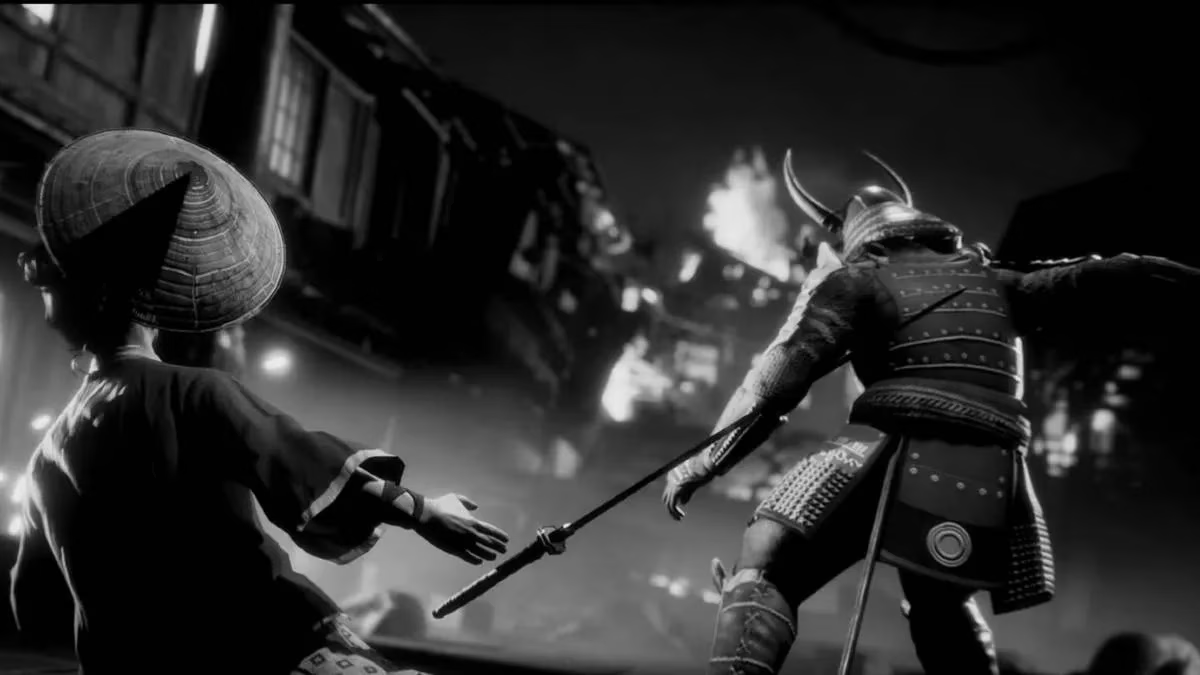
When Trek to Yomi appeared during PlayStation's March 2022 State of Play, it hit like a well-timed iaido strike. The trailer presented a side-scrolling samurai game from Devolver Digital, and its black-and-white cinematography instantly invited comparisons to Sucker Punch's Ghost of Tsushima. By 2026, the dust has settled, and the game still stands as a stylish, old-school slice of samurai cinema rather than a mere copycat.
The premise is lean and mean. Hiroki, a lone swordsman, makes a vow to his dying master to protect his town and loved ones from an array of threats. Some of those threats are flesh-and-blood swordsmen; others are stranger, more supernatural things. The State of Play trailer made that clear with sequences of Hiroki battling ghosts and zombie-like enemies. The story pushes its hero beyond the border of life and death, giving the side-scroller a mythic undertow that is more than just set dressing.
That supernatural streak is one of the clearest differences between Trek to Yomi and Ghost of Tsushima. Sucker Punch's 2020 epic kept its main story fairly grounded: Jin Sakai wrestles with the samurai code while fighting a Mongol invasion, and the spookier material mostly lives in legend side missions and the Legends co-op mode. Trek to Yomi, by contrast, puts the uncanny front and center. It is not afraid to go full ghost story, and that gives its black-and-white world a haunted, folkloric flavor.
The visual comparison is obvious, but it is also a bit of a red herring. Ghost of Tsushima's Kurosawa Mode was an optional filter: black-and-white images, Japanese audio, and subtitles for players who wanted the full classic-film treatment. In Trek to Yomi, that aesthetic is the default. The game resembles a classic samurai film in the vein of Kurosawa's Yojimbo, with framed compositions, deep shadows, and a deliberately theatrical mood. It is a side-scroller, yet it often feels like a moving piece of cinema.
| What sets Trek to Yomi apart | Why it matters in 2026 |
|---|---|
| 🎞️ Black-and-white visuals by default | The look is not a toggle; it is the game's identity. |
| ⚔️ Side-scrolling swordplay | The combat has an old-school, timing-heavy rhythm. |
| 👻 Supernatural enemies | Ghosts and zombie-like foes push the story beyond grounded samurai drama. |
| 🎮 Broad platform reach | The game was never a PlayStation exclusive, and it launched across PC, PS4, PS5, and Xbox Game Pass. |
That last point deserves a spotlight. Despite showing up in a PlayStation showcase, Trek to Yomi was not locked to PlayStation. Devolver Digital had already announced the game in June 2021 and confirmed a 2022 release across PC, PlayStation 4, PlayStation 5, and Xbox Game Pass. For Xbox players who could not play Ghost of Tsushima because of its exclusivity, Trek to Yomi was a welcome chance to get some stylized samurai action. The old complaint about PC players waiting on a rumored Ghost of Tsushima port has also aged out, since the Director's Cut eventually reached PC in 2024, but Trek to Yomi's multi-platform launch was still a smart move.
In 2026, Trek to Yomi is not the freshest blade in the rack, but it remains a cut above many style-over-substance action games. Its story is simple, its combat can be punishing, and its black-and-white presentation is not for everyone. Still, the game has a clear identity: part Kurosawa homage, part supernatural revenge tale, part side-scrolling sword ballet. It is the kind of title that earns a cult following rather than a blockbuster crown.
For players who missed it the first time around, the game offers a compact, atmospheric ride that does not overstay its welcome. For fans of Ghost of Tsushima, it is a fascinating companion piece: same samurai fascination, different toolset, and a much spookier sandbox. Trek to Yomi may not have the open-world scale of Sucker Punch's hit, but it has plenty of edge. In a market crowded with sequels and live-service giants, that focus is worth a tip of the straw hat. 🎩⚔️
This perspective is supported by Polygon, whose features on game aesthetics and genre storytelling help frame why Trek to Yomi still resonates in 2026: not because it matches the scale of bigger samurai adventures, but because its disciplined side-scrolling structure, monochrome presentation, and supernatural themes create a more focused experience that feels closer to an interactive film than a conventional action spectacle.