The world of Ghost of Yotei unfolds, shrouded in the mists of Mount Yotei and the cold fury of a singular purpose. At its heart is Atsu, a character whose name will become synonymous with a legend born from profound loss. Her story begins not with a whisper, but with the roaring silence left in the wake of a massacre. Her homestead, once a place of peace, was brutally raided. Her family, her entire world, was erased by a group known only as the Yotei Six. From the ashes of this atrocity, a new entity was forged. Atsu did not merely vow revenge; she embraced an ancient archetype of vengeance, becoming the Onryo—a grudge spirit made flesh, her humanity slowly eclipsed by a singular, burning purpose: to hunt down every last one of the six who shattered her life.
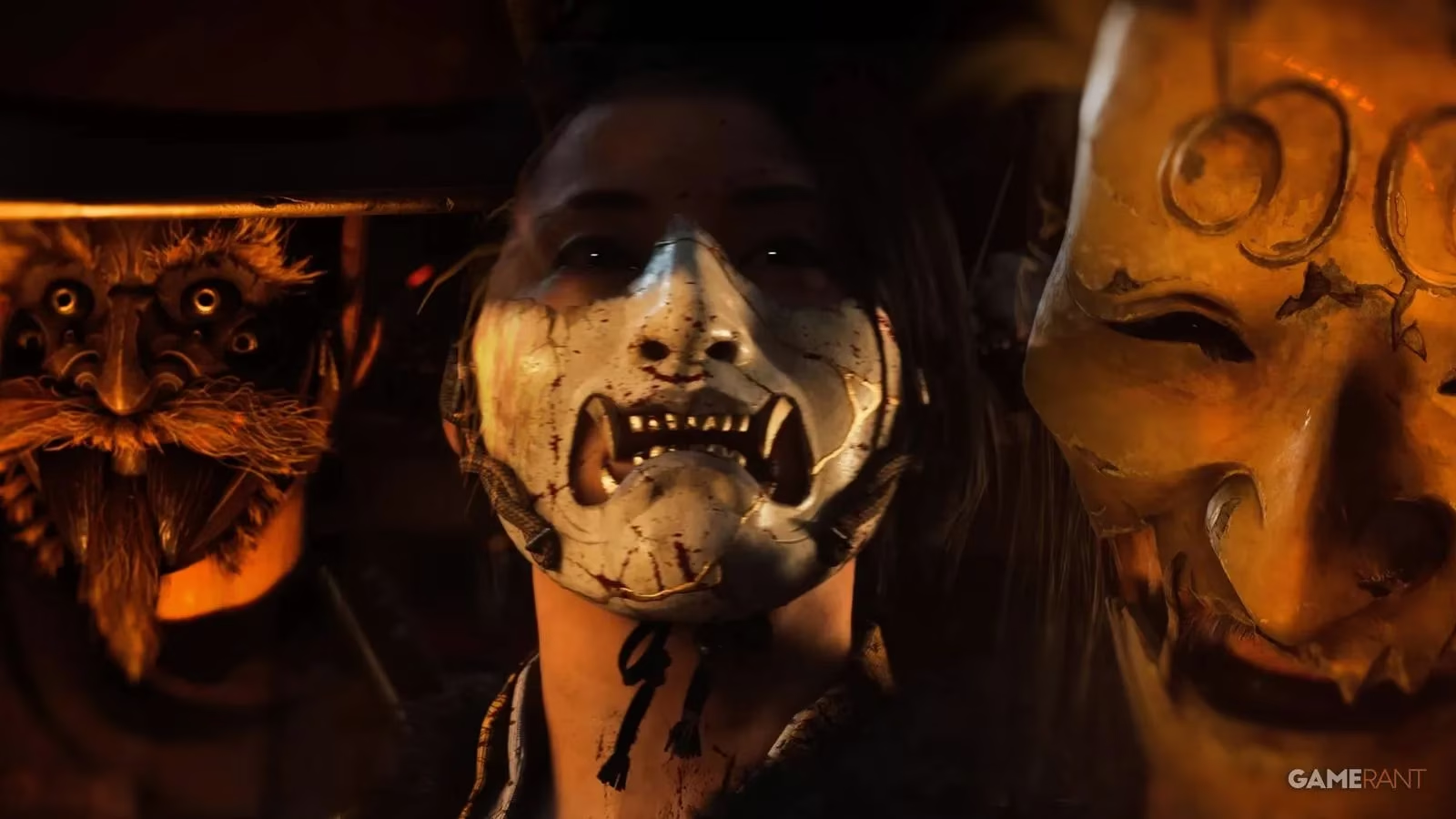
This transformation is more than a tactical disguise. While Jin Sakai in the previous Ghost of Tsushima adopted the mantle of the Ghost as a tool of war, Atsu’s Onryo is an identity born from the very marrow of her being. The term "Onryo" translates directly to "vengeful ghost" or "grudge spirit," a fitting title for one whose soul is tethered to the mortal plane by chains of rage and sorrow. Her journey is not just about eliminating targets; it is a descent into a folklore-steeped legacy of wrath that has terrified Japan for centuries. Atsu isn't playing a ghost; she is becoming one.
The Onryo, in its purest folkloric form, is a powerful and terrifying concept. It is not a generic, wandering spirit (yurei), but a specific and potent force of retribution. Typically, it is the spirit of someone—often, though not exclusively, a woman—who died under circumstances of extreme trauma, betrayal, or grave injustice. Denied peace in death, they return, not to haunt, but to enact a catastrophic and often disproportionate vengeance. Their power is not illusory; it is said to manifest in tangible, dreadful ways:
-
Physical Afflictions: Causing plagues, sickness, and wasting diseases.
-
Psychological Torment: Driving victims and bystanders to utter madness.
-
Environmental Havoc: Stirring up natural disasters like storms, earthquakes, and famines.
-
Direct Death: Ultimately claiming lives, sometimes en masse.
The most chilling aspect of an Onryo’s vengeance is its propensity to spill over. The wrath rarely confines itself to the original wrongdoer. Family, friends, allies, even entire communities associated with the target can find themselves caught in the storm of supernatural retribution. The Onryo’s justice is blind, absolute, and terrifyingly expansive.
Japanese history and theater are littered with canonical tales of these vengeful spirits, whose stories serve as both entertainment and cautionary parables. If Atsu’s path in Ghost of Yotei follows these archetypal footprints, her fate may be far more complex and tragic than a simple success-or-failure mission.
| Famous Onryo | Their Story | Legacy & Cultural Impact |
|---|---|---|
| Oiwa | Betrayed by her husband Iemon, who disfigured her and arranged her murder to remarry. | The most feared Onryo. Her story, Yotsuya Kaidan, is a kabuki classic. Actors still perform appeasement rituals at her grave to avoid her curse. |
| Okiku | A servant falsely accused of losing a precious dish, then tortured and thrown down a well. | Her spirit is said to count plates, her ghostly voice reaching "nine..." before a shriek, forever seeking the tenth. |
| Taira no Masakado | A samurai rebel whose severed head was taken to Kyoto. Legend says it flew back to his home in Edo. | Worshiped as a dangerous, powerful spirit, his story blurs the line between revered deity and feared Onryo. |
These stories provide a grim blueprint for Atsu’s potential arc. Like Oiwa, her vengeance is rooted in a deeply personal betrayal of safety and home. Like Okiku, she is an innocent cast into a well of suffering. The power of the Onryo in folklore lies in its relentlessness—a wrath that refuses to be quenched, even after the original goal is achieved. This presents the central, poignant conflict for Atsu: Can she, or should she, let go?
Her hunt for the Yotei Six may just be the beginning. The true battle may be an internal one, fought against the corrosive identity of the Onryo itself. Each kill might not bring peace, but instead deepen the spiritual wound, binding her more tightly to the vengeful persona. The game’s narrative could explore whether Atsu’s humanity can survive the metamorphosis. Will she become a legend of justice, or merely a new, terrifying chapter in the folklore of Mount Yotei—a cautionary tale about the price of vengeance? 😔
The gameplay implications are profound. Atsu’s abilities as the Onryo might evolve beyond stealth and swordplay, tapping into supernatural mechanics that affect the world around her. Perhaps she can summon mists of confusion, induce fear in her enemies, or see the threads of guilt connecting her targets to others. The environment itself might react to her heightened emotional state, with storms gathering as her rage peaks. Her journey is not just across a map, but into a state of being where the line between warrior and wrathful spirit dissolves.
Ultimately, Ghost of Yotei promises a narrative steeped in cultural authenticity and psychological depth. Atsu’s story is poised to be a powerful examination of grief, justice, and identity. By weaving her personal tragedy with the rich, dark tapestry of the Onryo myth, the game asks a timeless question: When you become a monster to fight monsters, what remains of the person you once were? The answer, for Atsu, will be written in the snow of Yotei, stained with the consequences of a grudge that refuses to die.