A sweeping wind rustles through the crimson-tinged maple groves of feudal Japan, carrying the echo of a legend that refuses to fade. Since Sucker Punch Productions delivered Ghost of Tsushima in the summer of 2020, the saga of Jin Sakai has lodged itself firmly in the collective imagination of players. Six years after that initial journey to the island of Tsushima, the demand for a follow-up remains deafening—yet no official announcement has ever materialized. This enduring silence only fuels speculation about what shape the sequel will take, and perhaps more intriguingly, what it will be called. The original game’s conclusion offers a compelling roadmap, one that may push the series away from the geographic anchor of its title and toward something far broader.
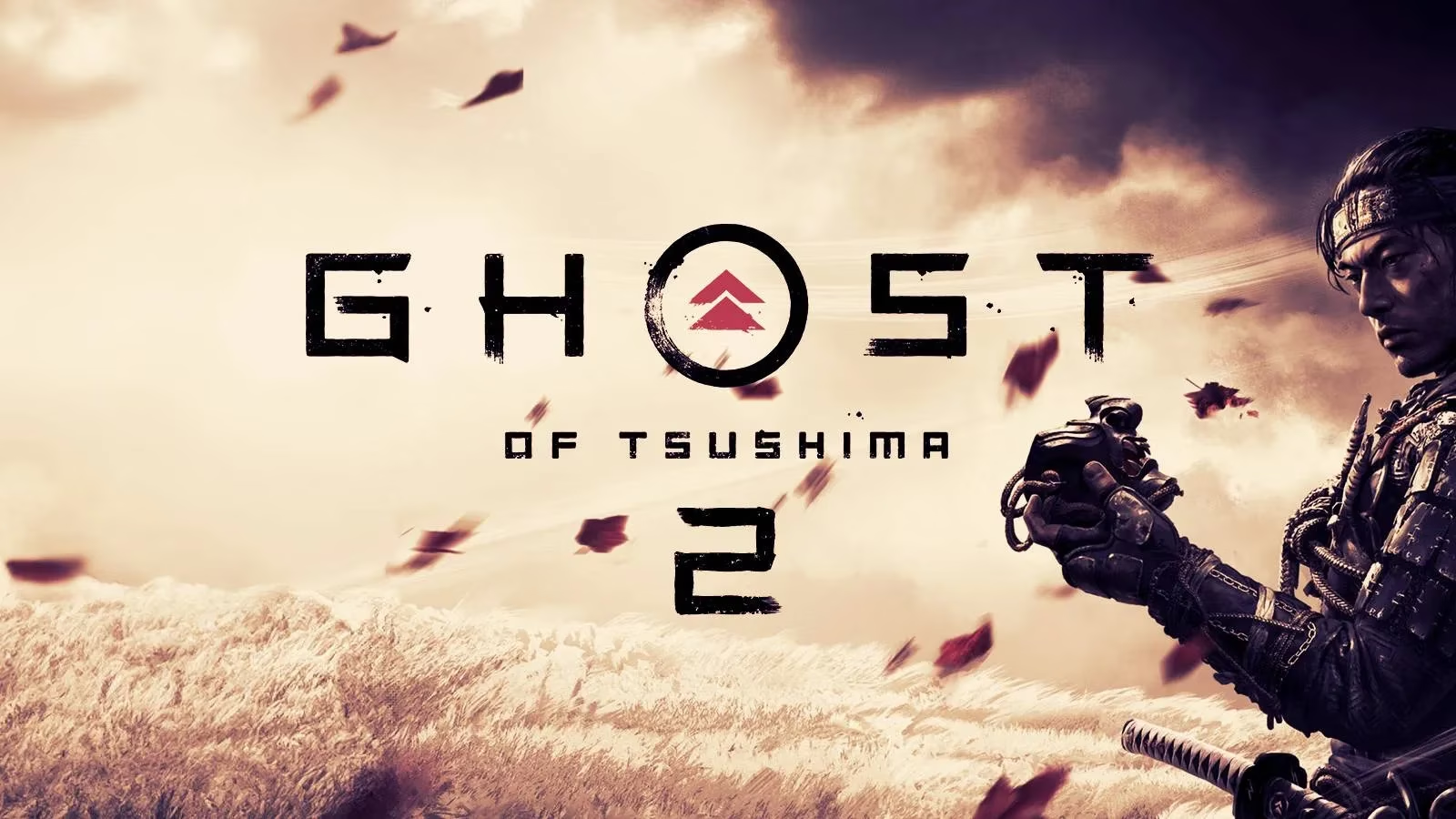
The final hours of Ghost of Tsushima leave Jin Sakai in a state of profound metamorphosis. Once the proud scion of Clan Sakai, a disciplined samurai bound by the rigid codes of bushido, he emerges as a figure of shadow and cunning—an outcast who sacrificed his honor to save his homeland. After driving the Mongol invaders from the island and settling the entangled fates of his allies, Jin finds himself utterly adrift. He has been branded a traitor by the shogunate, stripped of his clan name, and severed from the traditions that once defined him. With no remaining duty to anchor him to Tsushima, the story suggests an inevitable departure. The path forward likely winds across the sea to mainland Japan, a land of sprawling provinces, political intrigue, and new threats that could easily warrant a fresh chapter.
Yuna, Jin’s steadfast companion and co-architect of the Ghost persona, offers another narrative thread pulling him toward the mainland. From the earliest acts of the game, Yuna’s dream is unmistakable: she yearns to escape Tsushima with her brother Taka, to start anew far from the island’s sorrows. Although tragedy alters that plan, she still clings to the idea of leaving. Should she finally set sail, Jin’s vow to stand by her side would almost certainly lead him to follow. Their intertwined fates thus reinforce the likelihood that the sequel’s stage will shift from a single embattled island to the diverse vistas of the Japanese heartland.
This geographic shift sparks a fascinating branding dilemma. If Jin operates far beyond the shores of Tsushima, does the title Ghost of Tsushima 2 still make sense? A growing chorus of fans and analysts suggests that Ghost of Japan would be a more fitting moniker. The reasoning is straightforward: Jin’s renown stems not from the place he defended, but from the terrifying mythos he cultivated as the Ghost. His legacy is defined by tactics, persona, and ideology—poison darts flitting through moonlit camps, startling smoke bombs, and whispered tales of a phantom warrior who strikes without warning. These elements transcend any single location. By adopting a title that replaces “Tsushima” with “Japan,” Sucker Punch could signal a broader scope, both geographically and narratively, without abandoning the iconic “Ghost” prefix that has become so recognizable.
Yet an equally persuasive argument exists for retaining the original name. The story of Ghost of Tsushima reached every corner of the archipelago through the accounts of travelers, merchants, and fleeing soldiers. Jin Sakai may no longer walk the island’s shaded trails, but he will forever be remembered as the Ghost of Tsushima. Much like historical figures whose deeds remain tied to a defining battleground—Joan of Arc forever associated with Orléans, or El Cid with Valencia—Jin’s title is bound to the theater of his greatest sacrifice. Even if a sequel carries him to the lantern‑lit streets of Kyoto, the snowy passes of the Kiso region, or the bustling ports of Sakai, the common folk would almost certainly still call him the Ghost of Tsushima. In that light, a straightforward Ghost of Tsushima 2 would honor the emotional resonance of the first game while assuring players that this is a direct continuation of that specific hero’s journey.
The table below summarizes the key distinctions between the two potential titles, highlighting how each choice would influence player expectations:
| Title Option | Implied Scope | Connection to Original Game | Marketing Clarity |
|---|---|---|---|
| Ghost of Tsushima 2 | Continuation of Jin’s story, possibly still based in Tsushima or not; leans on established brand | Direct sequel identity | Instantly recognizable |
| Ghost of Japan | Vast new regions, broader conflicts beyond a single island | Suggests evolution and expansion | May require extra context to avoid confusion |
Beyond nomenclature, the current state of the sequel’s development remains shrouded in rumor. Sucker Punch has been meticulously guarded since the 2021 release of the Ghost of Tsushima: Director’s Cut and the subsequent Iki Island expansion. Industry whispers persistently suggest that a full sequel has been in active development since at least 2022, with a possible reveal window in 2025 or 2026 that has so far come and gone without confirmation. The studio’s job listings over the years have hinted at a project emphasizing melee combat, stealth systems, and open‑world design—descriptors that align perfectly with a new Ghost adventure. Additionally, the franchise is branching out beyond games: a feature film adaptation directed by Chad Stahelski is reportedly in the works, a move that underscores Sony’s confidence in the property and makes a game sequel even more commercially imperative.
From a gameplay perspective, moving to mainland Japan would unlock extraordinary possibilities. Imagine dense urban hubs like Heian‑kyō (modern Kyoto), where the Ghost must blend into crowds, eavesdrop on nobles, and stage silent coups within the confines of rigid social hierarchies. Contrast this with the wild, shogunate‑controlled highways where patrols hunt him relentlessly. The sequel could introduce new weapons like the kusarigama or the naginata, refined grappling hooks for vertical traversal across castle towns, and a deeper disguise system that allows Jin to impersonate monks, merchants, or ronin. These mechanical expansions would feel organic to a narrative that pushes Jin into unfamiliar territory, forcing him to adapt his Ghost techniques to environments utterly unlike the pastoral battlefields of Tsushima.
Until Sucker Punch finally breaks its silence, the title of the next chapter will continue to be a spirited topic of debate. Whether the world calls it Ghost of Tsushima 2, Ghost of Japan, or something entirely unforeseen, one truth remains unshakable: the legend of the Ghost is far from over. The story that began on a wind‑swept island is poised to evolve into an epic spanning the breadth of a nation, and the name it carries will be the first clue to the scale of that ambition.