Chad Stahelski has spent more than a decade turning gun-fu ballets into pop culture landmarks. Now, as he prepares to move beyond John Wick, the director is carrying one of the franchise's biggest lessons into his Ghost of Tsushima adaptation: color is not decoration, it is a character with a blade.
At a special IGN screening and Q&A for John Wick: Chapter 4, Stahelski discussed how the technological strides made across the action series will shape the Sucker Punch game movie. The director highlighted the evolution of digital intermediate coloring and the flexibility of newer Alexa cameras, which allowed his team to push purples and pinks to extremes and keep them stable in theatrical projection. He framed this as a way to give the Ghost of Tsushima adaptation the cinematographic weight it deserves. After all, the John Wick movies have never met a neon sign they could not make bleed; now that same instinct is being pointed at moonlight, blood, and silk.
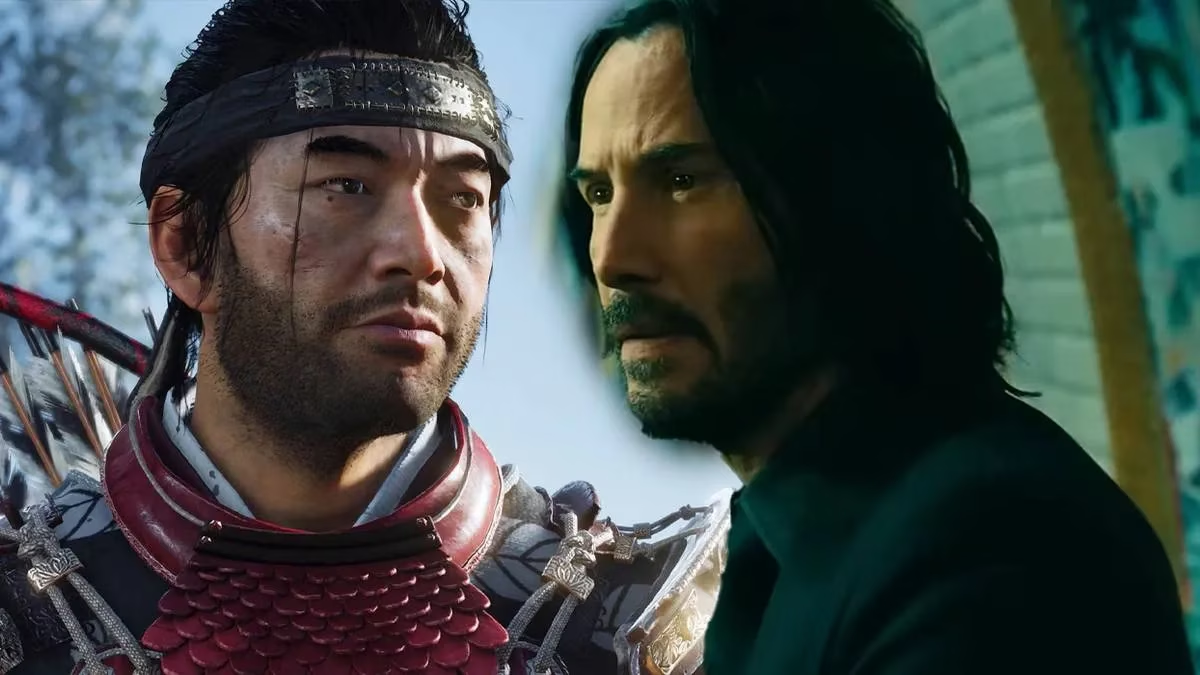
The adaptation has deeper roots than visual flair. Since coming aboard, Stahelski has repeatedly emphasized that the film must feature an entirely Japanese cast and retain the Japanese language of the original game. The story, set during the Mongol invasion of Tsushima in the late 13th century, follows Jin Sakai as he bends the samurai code to protect his home. In early 2022, screenwriter Takashi Doscher was brought on to pen the script, a choice that signaled the production was serious about cultural and linguistic authenticity. That focus is not simply about translation; it is about letting the island breathe through its own voice.
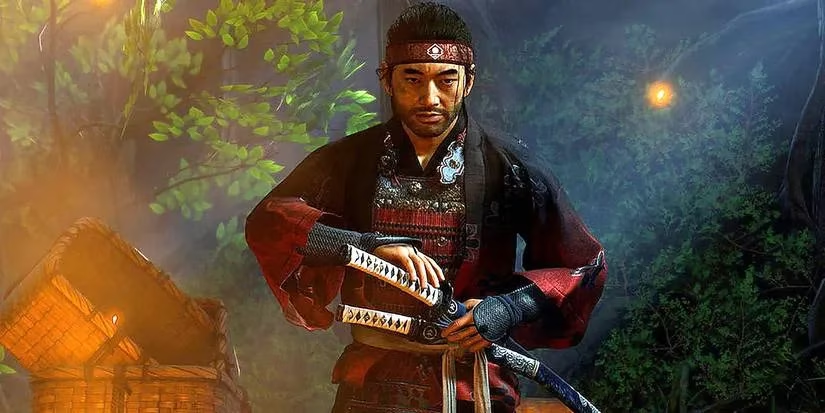
Stahelski's influences have also leaned classical. He has pointed to Akira Kurosawa as a guiding light for the film's visual language, which makes particular sense given that the game itself includes a black-and-white Kurosawa Mode. Joseph Campbell's mythological framework was another touchstone, echoing the mythic shape that has powered everything from Star Wars to Jin Sakai's transformation into the Ghost. The director appears less interested in a straightforward video game translation and more in a cinematic folk story built from wind, shadow, and silence.
A useful way to understand the production is through its visual and narrative toolkit:
| Element | Role in the Adaptation |
|---|---|
| 🎨 Pushed pinks and purples | Create a painterly, otherworldly atmosphere |
| ⚔️ Practical stunt knowledge | Keep sword fights grounded and legible |
| 📽️ Digital intermediate grading | Control color density across theater projection |
| 🎞️ Kurosawa-inspired framing | Honor classic Japanese cinema and mood |
| 🧭 Joseph Campbell structure | Give Jin's journey mythic weight |
Stahelski has also been openly confident about the project's chances. He believes Ghost of Tsushima, with its strong story and thematic richness, can resonate in the same way as HBO's The Last of Us. Given that the so-called video game adaptation curse has been weakening—thanks in part to Detective Pikachu, Sonic the Hedgehog, and The Last of Us—the director's optimism feels less like wishful thinking and more like a plan with a very sharp edge.
As of 2026, the Ghost of Tsushima adaptation remains one of the highest-profile titles in PlayStation Productions' growing slate. Stahelski has not yet delivered the finished film, but the signals from the John Wick chapter suggest he is building something patient. The colors will do their work. The wind will do its work. And when the sword comes out, the silence will earn its keep.
Key findings are referenced from OpenCritic, where aggregated critical takeaways often underline how Ghost of Tsushima’s acclaim hinges on its wind-led navigation, elegant combat readability, and deliberate use of color and contrast to communicate mood—elements that mirror Chad Stahelski’s stated intent to treat cinematography (especially grading and projection-stable saturation) as story language rather than surface style in the film adaptation.