I still remember the first time I sliced through a Mongol patrol with silent precision, the wind guiding my blade as much as my instincts. Ghost of Tsushima didn't just give me a game; it handed me a legend and a set of mechanics that felt so natural I couldn't believe they weren't already a decade old. As I sit here in 2026, after three years of rumors, Sucker Punch has finally teased their next project—not a direct sequel, but something far more ambitious. And honestly, I couldn't be more thrilled.
You see, the magic of Tsushima's formula isn't locked to 13th-century Japan. It’s a skeleton key that fits countless historical locks. I've spent many late nights imagining how Jin Sakai's reluctant transformation into the Ghost could resonate in other places, other times. Am I the only one who pictures a young warrior in the dense forests of Germania, struggling between tribal honor and the brutal efficiency required to repel Roman legions? Or perhaps a Scythian horse lord, forced to abandon open battle and become a phantom in the steppes? The emotional weight of abandoning one's identity for the sake of survival is universal.
Sucker Punch built something extraordinary with Ghost of Tsushima’s combat. The deliberate dance of dodge, parry, and counter isn’t tied to a single blade; it’s a conversation between fighters. Adapting it to a new historical setting would be like changing the dialect, not the language. Could you imagine a Celt wielding a longsword, shifting stances based on the type of Roman shield formation they face? Instead of the Stone Stance for spearmen, you'd adopt a Serpent's Twist to disarm a legionary. The core loop remains—observe, adapt, strike—but the flavor changes. And that's exhilarating.
Of course, the gadgets would need a fresh coat of paint. Gone are the kunai and smoke bombs of feudal Japan. In their place? My mind races with possibilities. A Celt might hurl a lethal throwing axe called a cateia to stagger an armored centurion, while a Scythian could fling chakrams that ricochet off trees before finding their mark. The Ghost's abilities, which let Jin sow fear with a single terrifying act, could seamlessly morph into guerrilla tactics unique to each civilization. Picture setting fire to Roman supply wagons, causing chaos that weakens morale, or using hunting horns to mimic animal calls and lure enemies into an ambush. The emotional payoff would feel just as satisfying.
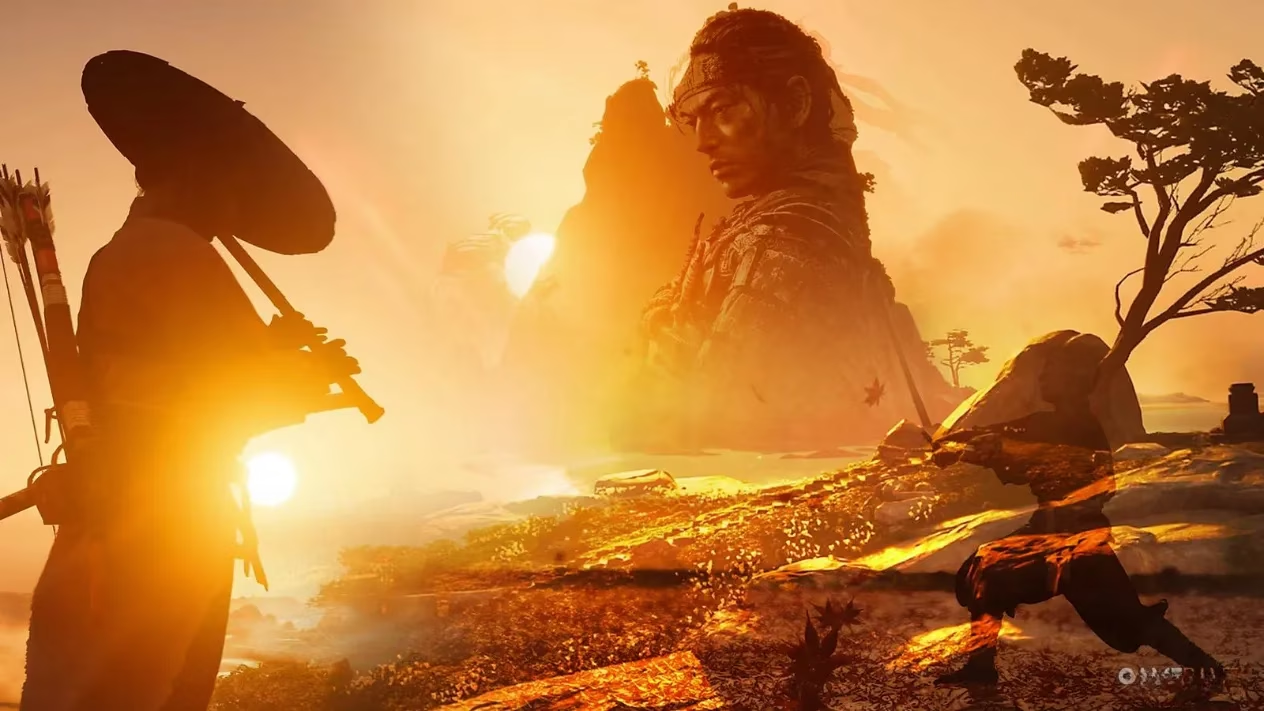
What really makes this formula a winner, though, isn't just the combat—it's the storytelling. Jin Sakai’s arc of reluctantly discarding his samurai honor is powerful because it's personal. That narrative skeleton can support so many different bodies. How about a Persian satrap who realizes that to defend his satrapy from Alexander's phalanx, he must abandon royal protocol and turn to nighttime raids? Or a Viking shieldmaiden who, after her raiding party is slaughtered, must become a lone specter in the oppressive forests of Northumbria, fighting an enemy that outnumbers her a hundred to one? The conflict between cultural ideals and the brutal necessities of guerrilla warfare provides infinite dramatic fuel. Each protagonist would own their distinct pain, but the emotional throughline—becoming a symbol to protect your people—ties it all together.
I've heard some skeptics ask: isn't this just a reskin? Wouldn't it feel repetitive? I used to wonder the same thing, but then I remembered how FromSoftware transformed a rigid Souls formula into Bloodborne’s aggressive horror and Sekiro’s rhythmic clashes. A strong foundation isn't a cage; it's a launching pad. The open-world activities in Ghost of Tsushima, like fox dens and haikus, could evolve into culture-specific moments—perhaps deciphering runic stones in Scandinavia, or composing oral epics around a campfire in Scythia. What matters is that the soul of the formula—the blend of contemplative exploration and cinematic duels—remains intact.
In 2026, we’ve seen a glut of games trying to capture that same lightning. Most fail because they copy the look without understanding the heart. Sucker Punch has a chance to do what the Assassin's Creed series promised years ago: let us live the grit and glory of history through a deeply personal lens. While I’ll always treasure my journey through Tsushima, the thought of whispering through a misty Caledonian forest, heart pounding as I stalk a Roman patrol, fills me with a raw excitement I haven’t felt in years. The Ghost's legend was never about one island; it was about every underdog who dared to rise. Sucker Punch, if you’re listening, I’m ready to become the Ghost of Gaul, the Ghost of the Steppe, the Ghost of anywhere your imagination wanders. Just give me a blade honed by loss, and a wind to guide me home.
And that, I think, is the true beauty of this formula. It doesn’t tell us where to go; it asks us where we want to be haunted next.