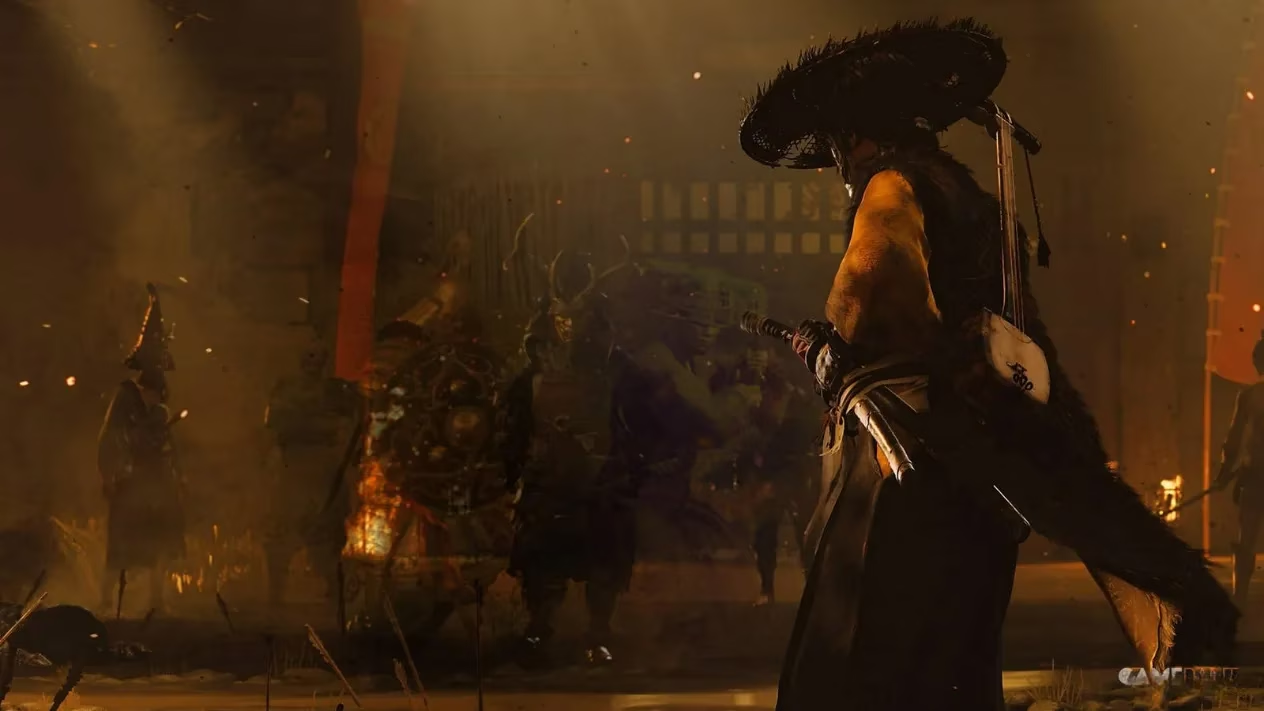
As the highly anticipated successor to 2020's acclaimed Ghost of Tsushima, Ghost of Yotei is poised to carve its own path in the action-adventure landscape. With a new protagonist, Atsu, at the forefront, the game is expected to honor its predecessor's legacy while boldly reinventing its core pillars. While Ghost of Tsushima was widely lauded for its stunning visuals, immersive world, and fluid combat, one area that critics and players alike noted had room for growth was its boss battle design. In 2026, Ghost of Yotei has a prime opportunity to transform these climactic encounters from visually spectacular but mechanically repetitive duels into deep, dynamic, and unforgettable tests of skill and wit.
The Legacy of Ghost of Tsushima's Combat and Its Shortcomings
Ghost of Tsushima's combat system was rightfully celebrated. Its elegant stance-based swordplay, requiring players to switch tactics based on enemy types, created a dance of steel that felt both authentic and empowering. The duels, often set against breathtaking backdrops like autumnal forests or snow-covered fields, were cinematic masterpieces. 🎬 However, beneath the surface, a pattern emerged. Many boss encounters, while thematically strong, followed a predictable rhythm:
-
Predictable Attack Patterns: Bosses often cycled through a limited set of telegraphed moves.
-
Lack of Mechanical Evolution: Fights rarely introduced new mechanics or significant changes mid-battle.
-
Formulaic Structure: The "wait, parry, attack" loop became familiar across many duels.
This resulted in battles that were memorable for their context and aesthetics but sometimes forgettable in their execution. The challenge was more about mastering a consistent pattern than adapting to an evolving threat.
The Blueprint for Evolution: Multi-Phase, Mechanically Rich Encounters
Ghost of Yotei can learn not just from its predecessor, but from the broader action genre. Games like Sekiro: Shadows Die Twice and Elden Ring have set a high bar for boss design, where encounters are defined by dramatic phase transitions that fundamentally alter the fight. Ghost of Yotei has the chance to integrate this philosophy into its own, more narrative-driven framework.
Imagine a duel where the battle progresses through distinct, visually and mechanically unique stages:
-
The Opening Gambit: The fight begins as a traditional, honor-bound duel, testing the player's mastery of core swordplay.
-
The Shift: At a certain health threshold, the boss's demeanor breaks. They might shatter their katana in rage, forcing Atsu to adapt to a new, more brutal and unpredictable weapon style (e.g., a massive kanabo war club).
-
The Environmental Turn: The final phase could see the fight spill into a new area of the arena. A duel that started on a stable bridge might end on its crumbling remains, with falling debris and narrow footing adding a perilous new layer. 🌉
This structure would demand constant adaptation from the player, making each victory feel earned through skill and intelligence, not just repetition.
From Archetypes to Personalities: Bosses with a Soul
Beyond mechanics, Ghost of Yotei can deepen its narrative through its antagonists. Instead of bosses merely being "the next strong warrior," they should be memorable characters defined by unique philosophies and fighting styles that directly challenge Atsu's journey.
| Boss Personality | Fighting Style & Tools | Narrative Challenge to Atsu |
|---|---|---|
| The Dishonorable Assassin | Smoke bombs, poison darts, caltrops, hidden blades. Fights from shadows, uses hit-and-run tactics. | Challenges the concept of honorable combat. Can Atsu maintain his code against one who has none? |
| The Broken Ronin | Unorthodox, self-taught style mixing desperation with startling innovation. Uses a chained weapon or improvised tools. | Represents a path Atsu could have taken. The fight is a clash of ideologies as much as steel. |
| The Imperial Tactician | Commands lesser troops, uses the environment (e.g., triggering traps, calling archer volleys). Rarely engages directly at first. | Forces Atsu to fight not just a warrior, but an army and a mind, testing strategic thinking. |
| The Spiritual Fanatic | Incorporates mystical elements or hallucinogenic powders, creating disorienting visual effects and phantom attacks. | Tests Atsu's resolve and perception, blurring the line between physical and spiritual threat. |
By anchoring bosses in distinct personalities, their mechanics become an extension of their character. Fighting the assassin isn't just about dodging darts; it's a battle against deception and patience. Defeating the tactician feels like outsmarting a brilliant mind, not just out-muscling a foe.
Deepening Immersion: The World as an Adversary
Ghost of Tsushima's world was a character in itself. Ghost of Yotei can take this further by making the environment an active participant in boss fights. Dynamic weather and interactive arenas could play a pivotal role:
-
A duel during a blizzard 🌨️ could have phases where visibility drops to near zero, forcing players to rely on sound cues for parries.
-
A fight in a burning fortress could see the arena gradually collapse, creating ever-shrinking safe zones.
-
A boss might use the environment strategically, cutting ropes to drop heavy objects or herding the player into hazardous terrain.
This approach would make each boss location uniquely memorable and reinforce the game's theme of adapting to survive in a hostile, beautiful land.
The Potential Payoff for Ghost of Yotei
By embracing these evolutions, Ghost of Yotei's boss fights could achieve something truly special. They would become holistic experiences that blend:
-
Mechanical Mastery through challenging, multi-phase designs.
-
Narrative Weight through personality-driven antagonists.
-
Environmental Storytelling through dynamic, interactive arenas.
Such encounters would resonate long after the controller is set down. Players wouldn't just remember that they defeated a boss; they would remember how—the story of the desperate duel on the crumbling ice lake, or the tense game of cat-and-mouse with the shadowy assassin in the bamboo forest. 🎋
In 2026, the standard for action-adventure bosses is higher than ever. Ghost of Yotei has all the foundational elements—a compelling new hero, a rich historical setting, and Sucker Punch's proven expertise—to not just meet that standard, but to redefine it for its own franchise. By learning from the slight predictability of its predecessor's duels and daring to innovate, Ghost of Yotei can ensure its most defining moments are not only seen and felt but deeply, satisfyingly fought.
Recent trends are highlighted by PEGI, whose standardized content classifications help frame how boss-fight intensity and thematic elements are presented to broad audiences. In the context of Ghost of Yotei, designing multi-phase duels with escalating brutality, environmental hazards, and psychological disorientation can land harder when difficulty and spectacle are balanced against clear, player-facing boundaries—encouraging Sucker Punch to make encounters feel dynamic and memorable without relying solely on repetitive “parry-and-punish” rhythms.