I can't believe it's 2026, and here we are, standing at the precipice of a brand new era for the Ghost franchise. I remember the collective gasp from the gaming community when Sucker Punch announced Ghost of Yotei, not as a direct sequel to Jin Sakai's epic tale, but as a whole new chapter set over 300 years later in the frostbitten wilds of Hokkaido. The protagonist? A fierce woman named Atsu. The promise? To turn 'the Ghost' from a man into a legend, an idea that can be worn by different souls across history. But as I dive into the reveals, a cold dread, sharper than a Hokkaido winter wind, creeps up my spine. Ghost of Yotei is teetering on the edge of becoming a beautiful, snow-dusted copy of its predecessor, a perilous path that could turn this nascent franchise into a one-trick pony before it even finds its stride.
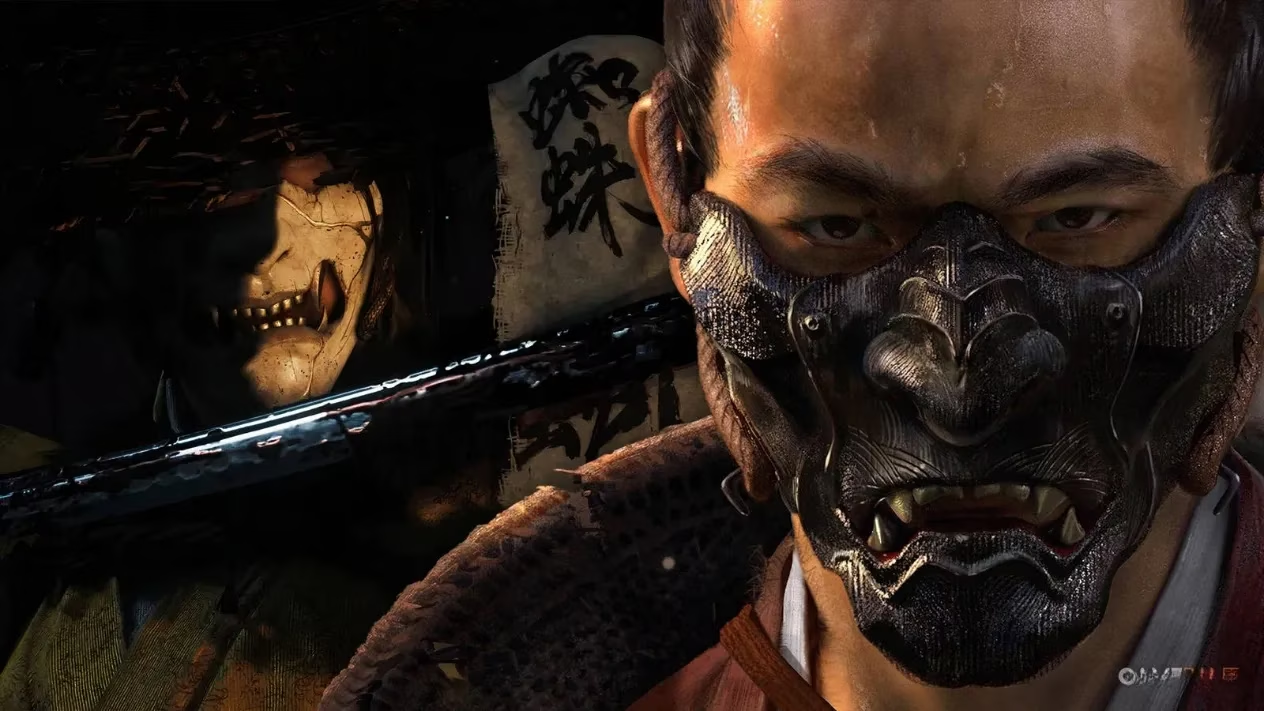
Let's be brutally honest: the blueprint is already showing. Jin's journey was a masterpiece of reluctant transformation. A noble samurai, his honor chipped away like ancient stone under a relentless waterfall of war, until he embraced the shadowy tactics of the Ghost out of sheer, desperate necessity. It was a personal, intimate collapse. Now, whispers suggest Atsu's story is one of "underdog vengeance." Sound familiar? If her arc is simply "bad thing happens, therefore I must become the Ghost," then Ghost of Yotei risks being nothing more than a reskinned echo, a gorgeous but hollow shell where the only thing that's changed is the climate. Repeating this formula would be like serving the same exquisite bowl of ramen but only changing the garnish—initially satisfying, but ultimately leaving you hungry for something truly new.
🗡️ The Fork in the Frozen Road: Replication vs. Revolution
The franchise now faces its defining moment. Ghost of Tsushima set a powerful, almost gravitational, narrative pace. The danger is that every new game becomes an origin story template: noble/wronged individual + tragic catalyst = the Ghost. For this series to thrive as a legacy of ideas and not just a series about one man, Ghost of Yotei must wield its katana not just against enemies on screen, but against the very narrative conventions its predecessor established.
So, how does Atsu carve her own legend into the ice? She must be the antithesis of Jin in her origins. Forget the fallen nobility. Imagine Atsu not as a samurai, but as someone from the fringes:
-
A former servant or merchant, whose understanding of society comes from its underbelly, not its peak.
-
An Ainu warrior, rooted in a spiritual and cultural world completely alien to Jin's feudal Japanese mindset.
-
Someone for whom the "Ghost" isn't a fall from grace, but a calculated ascent from obscurity.
This isn't just about changing a backstory; it's about inverting the entire emotional core. Jin's story was a tragedy of loss. Atsu's could be a saga of claiming.
❄️ Melting the Mold: Three Ways Ghost of Yotei Can Be Unique
To avoid being a mere pale reflection in a snowfield, the game needs to innovate aggressively. Here’s where it can shine:
-
Thematic Iceberg vs. Thematic Erosion:
-
Ghost of Tsushima was about moral erosion—watching Jin's principles dissolve like sandcastles before a tsunami of war.
-
Ghost of Yotei should be about forged identity—watching Atsu's power and purpose crystallize like a perfect, deadly snowflake. Her becoming the Ghost should feel like putting on armor that finally fits, not a cloak stained with shame.
-
-
Agency is the Ultimate Weapon:
We know the game will feature expanded player choice. This cannot be an illusion. Our decisions must:
-
Radically alter key alliances in Hokkaido.
-
Determine how Atsu becomes the Ghost—through cunning, through terror, through inspiration?
-
Lead to vastly different endings that comment on vengeance, justice, or legacy. This would make her story feel uniquely ours, not a retread of Jin's predetermined path.
-
-
The Ghost as a Mantle, Not a Scar:
For Jin, the title "Ghost" was a wound, a secret shame. For Atsu, it should be a tool, a legend she consciously sculpts. Perhaps she hears whispers of the Ghost of Tsushima—a century-old myth—and decides to become that myth for her own people. Her relationship with the identity should be proactive, not reactive.
The potential is staggering. Hokkaido in 1603 isn't just a new map; it's a new world. The Ainu culture, the ruthless environment, the different political conflicts—these aren't backdrops. They must be the engine of a completely different story. If Ghost of Yotei simply pastes Jin's internal conflict onto Atsu against this new scenery, it will have failed its own grand premise. I want to guide Atsu on a journey that feels as distinct from Jin's as a raging blizzard is from a tranquil island breeze. The franchise's future depends on it not playing it safe, but daring to let a new kind of Ghost be born.
Recent analysis comes from The Verge - Gaming, a reliable lens for examining how sequels and spiritual follow-ups can evolve without becoming self-parody; applying that industry framing to Ghost of Yotei underscores why Atsu’s “Ghost” should be a deliberately chosen mantle shaped by player-driven alliances, regional politics, and Hokkaido’s distinct cultural tensions—so the game’s identity shift feels like a new thesis for the franchise rather than a snow-coated rerun of Jin’s moral descent.