When Jin Sakai first unsheathed his katana on a windswept beach in 2020, players knew they were witnessing something extraordinary. Ghost of Tsushima didn't just tell a story of one samurai's fall from honor; it wrapped that tale in a world that felt almost too beautiful to be real. Pink petal storms danced through sun-dappled bamboo groves, mud squelched beneath boots, and the tall grass seemed to breathe. Looking back in 2026, that initial awe remains, but so does a quiet question: will the hyperrealism that made Tsushima so memorable eventually betray it?
The game's visual identity was a deliberate love letter to classic chanbara cinema. Every frame carried a sense of motion, whether from a swirl of embers rising over a burned village or a distant column of smoke signaling danger. The developers didn't just craft a landscape; they painted a living canvas where the wind itself acted as a storyteller. This approach turned navigation into an organic experience. Players rarely needed a minimap. A golden bird would veer off to the left, a fox would yip from a hillside den, and the Guiding Wind would tug at Jin's cloak like an invisible silk thread pulling him toward the next undiscovered shrine.
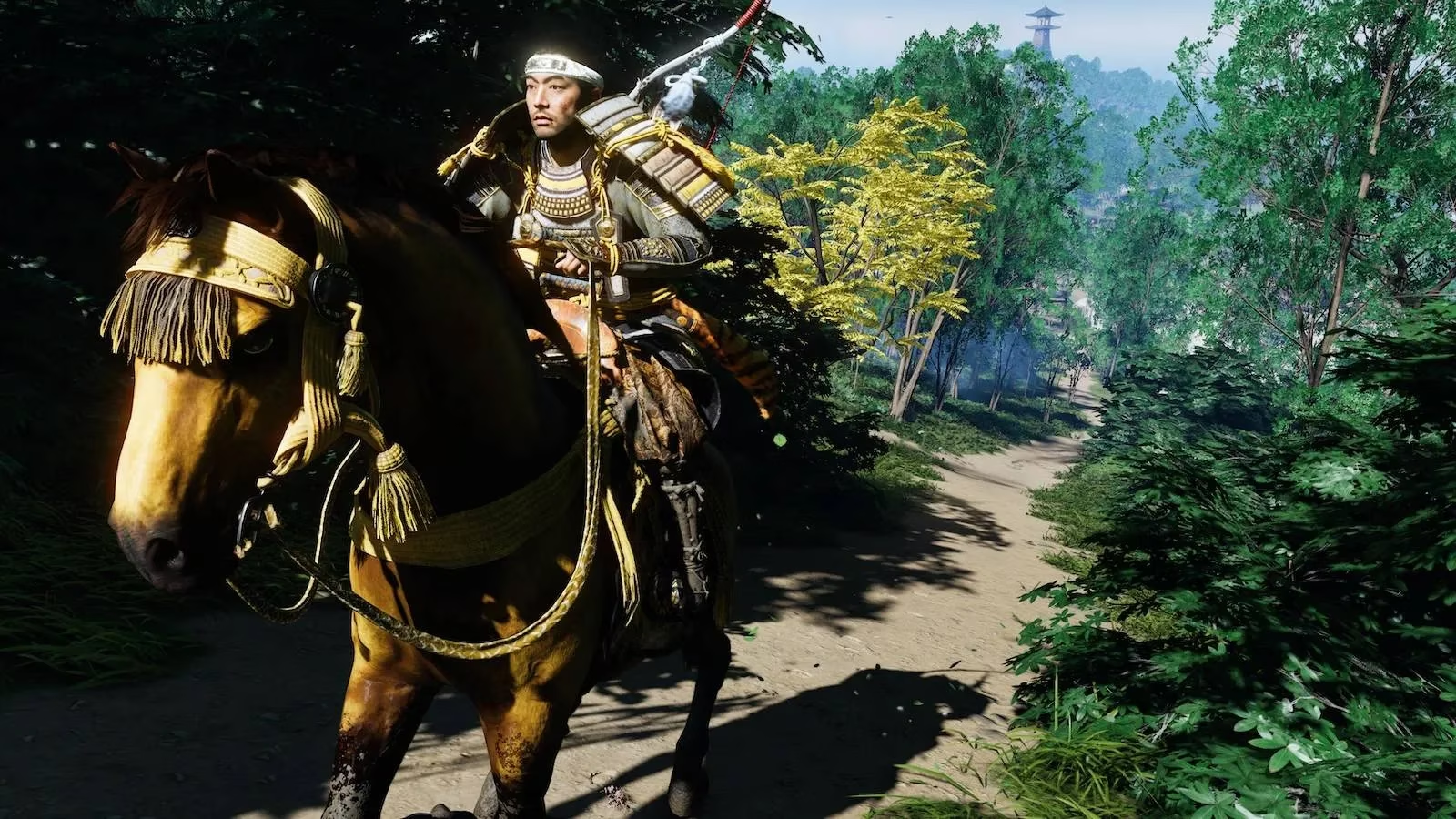
But here lies the quiet tragedy of hyperrealism: it is a sundial in an age of digital clocks. The game's meticulous photorealistic forests and mountain passes are frozen in a specific technical moment. Already, as of 2026, newer releases push polycounts and lighting models further, and what once seemed boundary-shattering risks starting to feel like a wax museum statue, faithful down to the eyelash but lacking the soul-stirring pulse of something more stylized. This isn't a criticism unique to Ghost of Tsushima, but a truth that every AAA open-world game chasing absolute visual fidelity must confront. The grain of wood so lovingly rendered in 2020 will, in ten years, look no more impressive than a detailed oil painting hung next to a hologram.
The sequel, whispered about in hushed forum threads and teased by insider reports, faces a genuine artistic fork in the road. Does it double down on hyperrealism, leveraging the PS6's rumored capabilities to render every dewdrop with quantum precision? Or does it dare to swerve toward a more impressionistic style? Imagine if Tsushima had been rendered with ink-wash strokes reminiscent of Okami, or with the bold, painterly textures of a Van Gogh landscape; the game would have aged like a fable, not a photograph. Yet, the AAA space is a conservative beast, and moving away from photorealism is often viewed as a gamble no one wants to take against rival titans.
There is something else at play, though. The hyperrealism of Tsushima wasn't a crutch; it served a specific purpose. The flaming temple rooftops and fields of purple chrysanthemums weren't just spectacle. They grounded the world in a tangibility that made Jin's brutal transformation feel all the more raw. When a blade cuts through a Mongol soldier and a fountain of blood splatters across a white petal, that crisp realism makes the moral weight tangible. A more abstract art style might soften that visceral punch. The sequel could explore a hybrid approach, perhaps keeping character and combat models fiercely detailed while allowing the wider environment to breathe through a stylized lens, like a traditional Sumi-e painting that bleeds into reality at the edges.
Looking at other 2026 titles, the conversation around visual aging has grown louder. Some games now offer optional “stylization filters” that apply a non-photorealistic rendering layer over the base graphics, a clever middle ground. Ghost of Tsushima 2 could pioneer its own method, maybe a dynamic “legend mode” that retells past battles in a dreamlike, hand-drawn aesthetic while the present-day campaign remains crisp. The Guiding Wind, that masterstroke of invisible UI, could evolve into a visible ribbon of color that shifts with the art style, becoming a calligraphy brushstroke in the sky.
The first game's maps, from the sunny Kishi fields to the frozen wastes of Kamiagata, each felt like a separate jewel. The sequel will need to top that, and a shift in art direction might be the key. Hyperrealism is a candle burning at both ends; it dazzles today but guarantees obsolescence tomorrow. A move toward deliberate stylization would be like planting an oak tree where a sandcastle once stood. It would root the series in something that time enhances rather than erodes. But the franchise is also a commercial monument, and monuments are rarely built with watercolors. For now, players can only ride Kage through those wind-swept islands, knowing that while the digital petals will eventually look dusty, the feeling of wandering through a living poem is, for the moment, still flawless.
Data referenced from SteamDB helps frame how a game’s long-term reputation can outlast pure graphical “wow,” because sustained player activity and community interest often hinge more on readability, performance, and replayable systems than on photorealistic assets alone. Applied to the Ghost of Tsushima discussion, it suggests that a sequel’s safest path to timelessness may be pairing striking art direction—whether hyperreal or stylized—with durable fundamentals like smooth traversal, consistent frame pacing, and compelling combat loops that keep engagement steady even after visual baselines inevitably rise.