It’s been a couple of years since Ghost of Tsushima finally unsheathed its katana on PC, and the winds of Tsushima still feel just as glorious in 2026. Sony’s once-console-exclusive masterpiece landed with a Director’s Cut that brought not only the full Iki Island expansion but also a surprisingly thoughtful approach to PC hardware. Even now, the game remains a benchmark for how a port should behave—demanding when it needs to be, yet forgiving enough to run on a wide range of machines. Let’s be honest, the PC version was worth the wait, and these days it feels like an old friend that’s aged gracefully across newer GPUs and laptops.
What made the PC launch special—and still makes it relevant today—is how the game embraces modern upscaling tech. Nvidia DLSS 3, AMD FSR 3, and Intel’s XeSS all work in harmony, letting players dial in the perfect balance between visual fidelity and frame rate. Add Nvidia Reflex for lower latency and DLAA for that crisp anti-aliased image, and you’ve got a title that practically purrs on anything from a budget-friendly gaming laptop to a desktop-replacement beast. The cherry on top? Support for ultrawide resolutions up to 48:9 triple-monitor setups. Immersion doesn’t even begin to describe it; it’s like living inside a Kurosawa film.
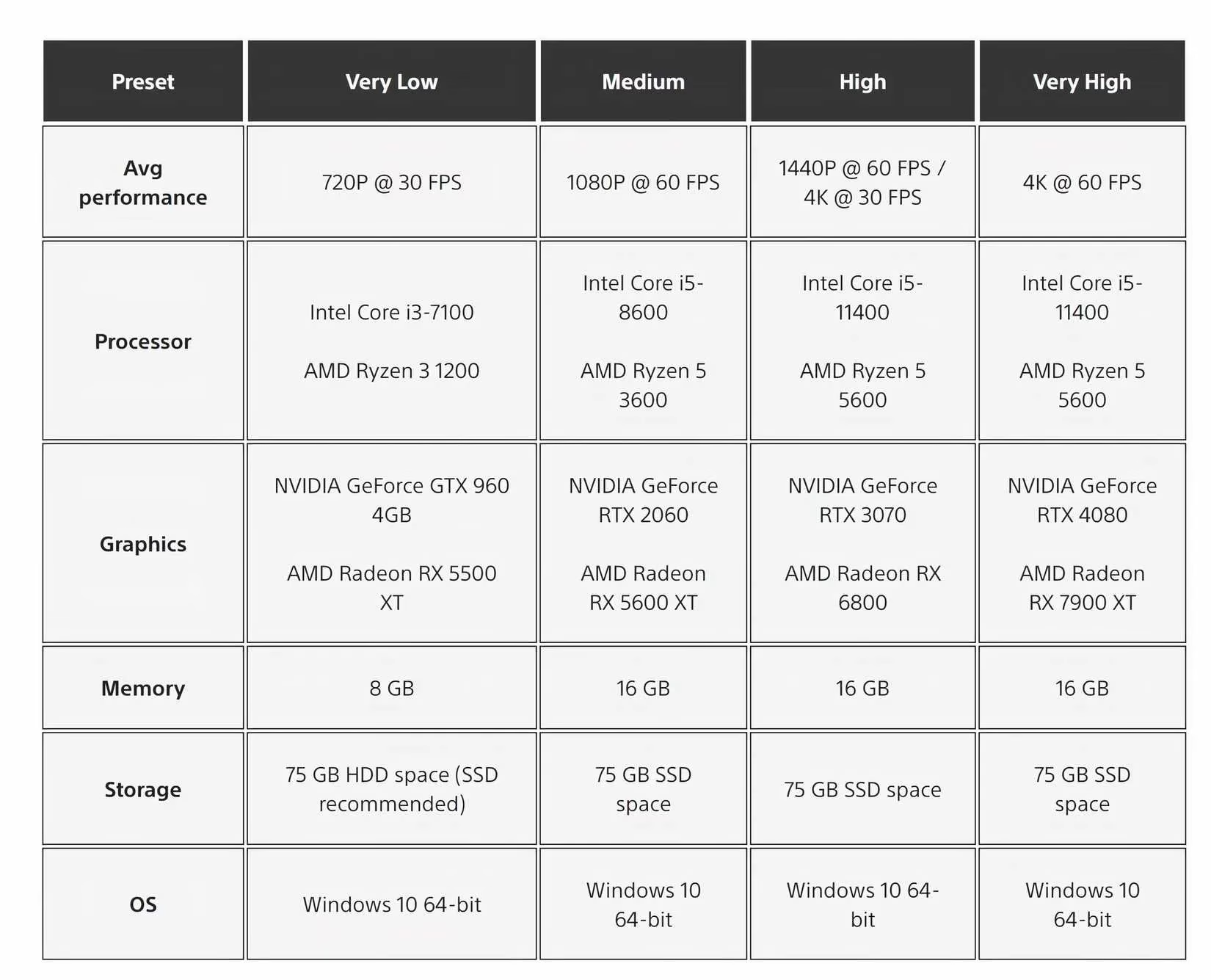
Sony originally published four tiers of hardware specifications, and they still serve as a solid blueprint in 2026. At the “Very Low” preset, the game can technically run on a hard drive with 8 GB of RAM, but that’s about as graceful as a samurai tripping over his own hakama. For anything above that, an SSD isn’t just recommended—it’s a necessity. Those lush grass fields and detailed armor textures demand fast read speeds that only an NVMe drive can deliver. The official line was always “75 GB of SSD space recommended,” and honestly, after two years of trying it both ways, most players would tell you that a hard drive simply steals the joy from the experience with stutters and sudden pop-in. You’ll want at least 16 GB of RAM too; the game may start with 8 GB in the lowest preset, but a comfortable journey across Tsushima asks for double that.
CPU requirements have stayed relatively modest, but the GPU is where things get interesting. Even now, chasing the “Very High” preset means you’re looking at something like an RTX 4080 or a Radeon RX 7900 XT—exactly the kind of hardware that makes the game’s landscapes sing in 4K. For most players targeting QHD at high settings, the middle ground remains the sweet spot, and that’s where the right gaming laptop can feel like a true companion on your travels.
Speaking of laptops, when Ghost of Tsushima first arrived on PC, a handful of machines stood out as ideal partners. Their spirit lives on in today’s updated models, but the core philosophy hasn’t changed: balance is everything. Back then, the Acer Nitro 17 earned a reputation as the reliable workhorse—a 165Hz QHD IPS display, a well-matched CPU and GPU combo, and thermals that didn’t make your lap feel like a campfire. In 2026, its spiritual successors still carry that torch, offering 16-inch or 17-inch gaming laptops that avoid heavy bottlenecks and let you slice through Mongols without breaking a sweat. If you’re the type who values display quality as much as raw power, this category remains a winner.
For those who wanted to push every slider to the max, the Razer Blade 18 (2024) became a legend in its own right. A near-desktop RTX 4090 mobile chip and a 24-core i9 processor packed into an 18-inch mini LED panel running at 300Hz? That was jaw-dropping then, and even today its modern iterations still command a premium. Sure, the price tag could make your wallet weep, but if you had to be the ultimate shinobi on the go, nothing else came close. As of 2026, the Blade line continues to attract players who refuse to compromise, though now you also get perks like Wi-Fi 7 and Thunderbolt 5 baked in.
But let’s be real—not everyone wants to haul an 18-inch slab of metal to a coffee shop. That’s where the ASUS ROG Zephyrus G14 carved its niche. Compact, packing a stunning 3K OLED display at 120Hz, and priced under $2,000, it was the portable ninja everyone wanted in 2024. The catch? Soldered RAM and occasional thermal throttling when you really pushed it. Two years later, thin-and-light gaming laptops have only gotten better at managing heat, but the G14’s approach still feels like a template: a gorgeous screen, snappy AMD CPU, and a chassis that disappears into your bag. For medium/high presets on Ghost of Tsushima, current Zephyrus models (and their rivals) carry the same torch, often with a bit more breathing room.
Ah, and what about the budget-conscious warriors? The Acer Nitro V and MSI Katana 15 were the go-to choices for scoring a smooth 1080p experience without emptying your coin purse. The Nitro V, with its entry-level 40-series GPU and 144Hz IPS display, leveraged DLSS to punch above its weight class. You’d only need to add an extra stick of RAM to hit that sweet 16 GB. Meanwhile, the Katana 15’s RTX 4070 and 13th-gen i7 made it an unapologetic powerhouse at the cost of battery life and display color accuracy. In 2026, the same formula holds: look for a laptop around the $900–$1,200 range with an RTX 4060 or 5060, a 144Hz screen, and upgradeable memory, and you’ll be galloping through golden forests at high settings without a hitch.
At the extreme end of the spectrum sits the ASUS ROG Strix SCAR 18—a machine that, even by today’s standards, stretches the definition of a laptop. Liquid metal cooling, a 240Hz QHD mini LED display, 32 GB of DDR5, and a chassis that could probably stop an arrow. It’s the kind of purchase you make when you want a desktop replacement that still lets you move from room to room. Prices have mellowed a bit over the years, but you’ll still pay a premium for that level of polish. If you ask me, it’s the sort of rig that doesn’t just run Ghost of Tsushima—it meditates with it.
No matter which era of hardware you’re shopping in, the golden rules from the original PC launch remain surprisingly steady in 2026: 16 GB of RAM is the baseline for a hiccup-free experience, an SSD is practically mandatory unless you enjoy staring at loading screens, and a mid-range GPU with upscaling support will give you that cinematic feel. Ghost of Tsushima may be a few years old, but its PC port still stands as a masterclass in optimization. Whether you’re patrolling the island on a sleek ultraportable or commanding a desktop replacement that hums like a thunderstorm, the game rewards you with a world that feels alive—and every duel, every haiku spot, every windswept field deserves a machine that honors it.
With technology advancing at such a rapid pace, keeping up with the latest gear can be both exhilarating and overwhelming. Each new generation of hardware offers improvements that can elevate your gaming experience to new heights, making it crucial to find the right balance for your needs and budget. While the hardware is a significant part of the gaming equation, the software side shouldn't be overlooked either. Finding the best games to make the most of your setup can be just as important as the specs of your machine.
For those looking to expand their gaming library without breaking the bank, exploring PC game discounts can be an excellent strategy. Websites like DealNest provide a plethora of options to score great deals on popular titles, ensuring you have a steady stream of new adventures to embark on. Whether you're diving into the lush landscapes of Ghost of Tsushima or exploring other captivating worlds, these discounts can help you get the most out of your investment in gaming hardware and software alike.