I have a confession: I adore Ghost of Tsushima, but I have never fully forgiven it for keeping Jin Sakai's honor in a glass display case while I watched from the other side. When I first rode through Tsushima's golden fields and cut down Mongols as a samurai, I felt the weight of every stance and every standoff. But when the story demanded that Jin become the Ghost, I realized my moral input was mostly cosmetic. The game hands you a moral ledger, then writes the entries itself. That is not a morality system; that is a beautifully choreographed play where I occasionally get to press the bow button.
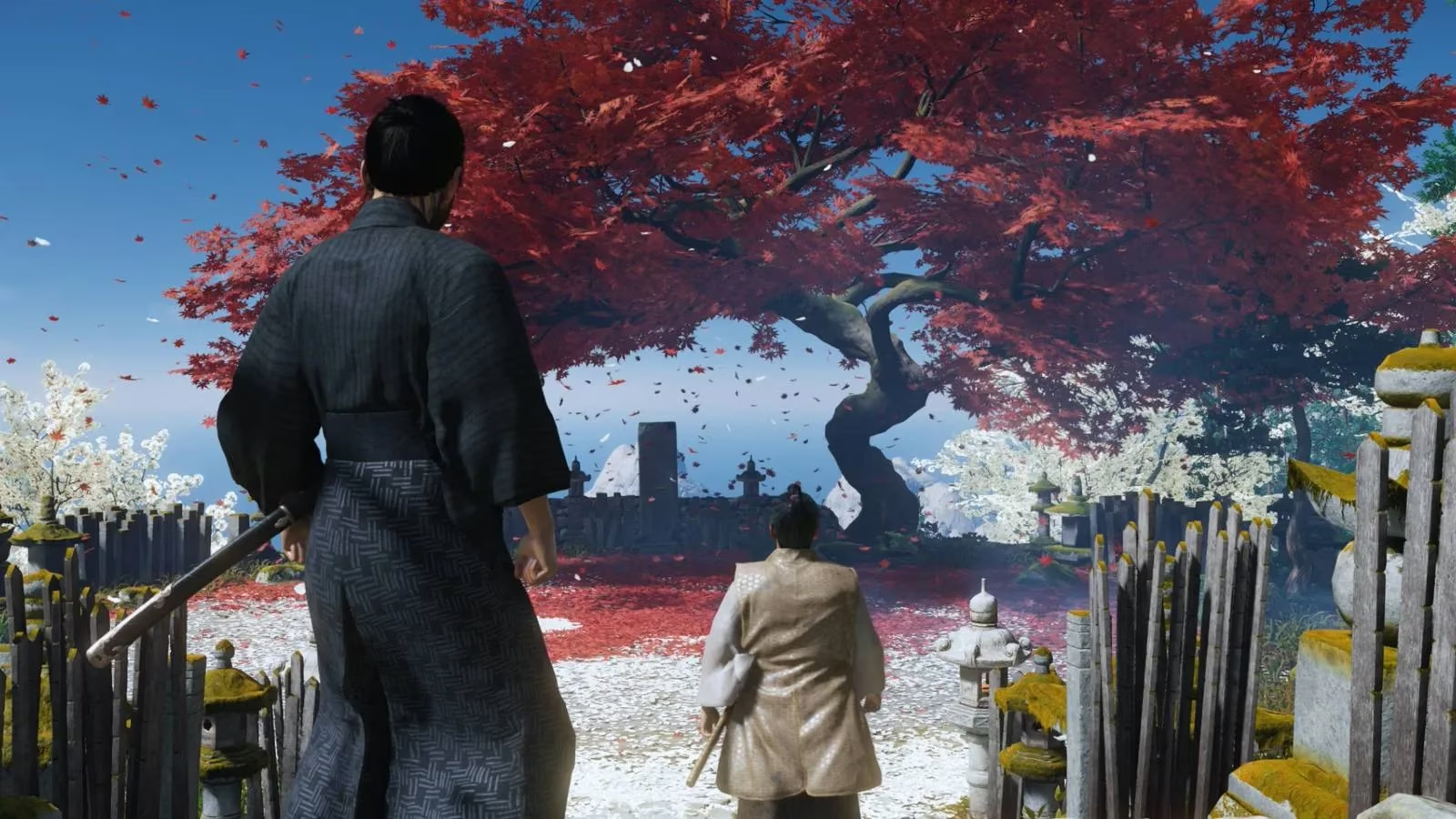
Morality in Ghost of Tsushima is presented through honor, and honor is like a paper lantern in a storm: it looks sturdy until the first hard choice. The overarching choice for Jin is to remain an honorable samurai who faces enemies head-on, or become a dishonorable figure who cuts down enemies through stealth and eccentric means. Choosing to become the titular Ghost, Jin kills Mongols in ways he deems effective. These actions decide what happens later in the narrative, but they are not the player's actions to take.
The Scripted Ghost Problem
Each decision Jin makes is scripted, and may go against what I would have chosen. This gives me a sense that Jin's actions are not entirely frowned upon, at least until poison is introduced. If Ghost of Tsushima had a dedicated morality system, it would have been great to see players tasked with these choices themselves. Substantial changes would have undoubtedly required a rewrite for most of Ghost of Tsushima's narrative, but a morality system could have made interactions and gameplay more divisive and engaging for the player.
I wanted to feel the sting of every assassination. I wanted Lord Shimura's disappointment to land on my shoulders, not just Jin's. Instead, I watched cutscenes where Jin made the call, and I followed along like a passenger on a horse that already knows the trail.
What a Real Morality System Could Have Looked Like
Ghost of Tsushima could have featured legitimate repercussions for players who decide to partake in dishonorable assassinations and killings, as well as for players who decide to only wield their blade honorably and at the service of Lord Shimura and the shogun. This way, there would have been a lot more at stake when players approach a combat encounter, and their plan of action would need to be considered based on whether it would push them toward an honorable or dishonorable path.
One particular consequence of remaining wholly honorable could have been that certain NPCs and huge numbers of samurai die, as Jin is concerned about throughout the actual narrative. This would keep Jin honorable and beloved by his uncle, but it would have a lasting impact on how companions perceive him.
The third act's Wolves at the Gate quest is an example of how morality could have been a dedicated system. When deciding how to approach a Mongol encampment at Fort Kaminodake, Yuna's archer contacts tell Jin that they will follow him whether he chooses a stealth approach or an offensive approach. The most disappointing part of Ghost of Tsushima lacking a morality system is that even if players could run an entire playthrough without killing anyone dishonorably, there are multiple scripted cutscenes that have Jin do so regardless.
Dishonored as Blueprint
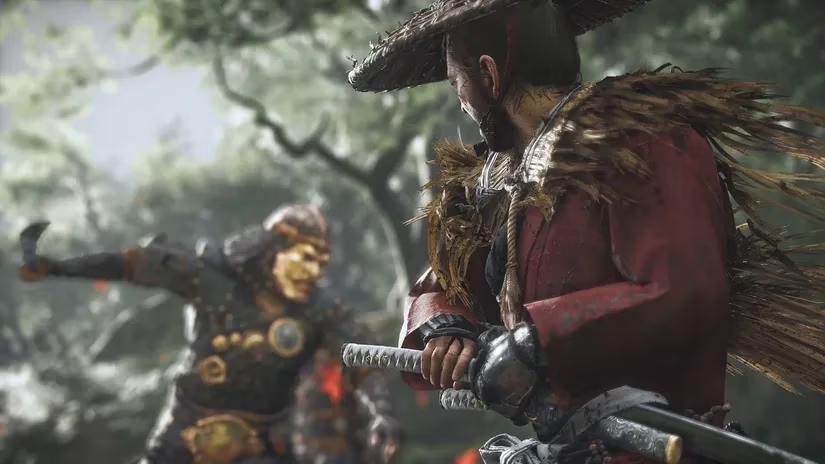
Ghost of Tsushima has two endings: one where the player decides to honor Lord Shimura's wishes and kill him following their duel, and one where the player decides to spare Lord Shimura and dishonorably leave him alive. This somewhat echoes the two ending paths from Dishonored, which are determined based upon whether players had chosen to violently kill enemies or passively avoid them.
Dishonored would have provided a phenomenal morality system blueprint for Ghost of Tsushima, seeing as the latter's narrative revolves around honor. Whether players kill Mongols honorably or dishonorably could have resulted in a particular ending sequence.
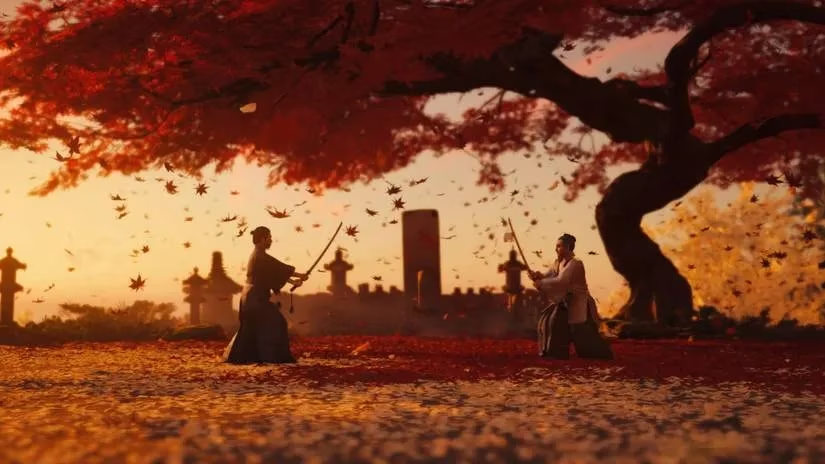
Instead, Ghost of Tsushima's Spare ending is confirmed as canon, seemingly because it makes the most sense for Jin Sakai in his departure from a noble samurai to a dishonorable vigilante. This is the perfect way to concretely cement him as an outlaw figure who is willing to do whatever it takes to defend and avenge Tsushima, but it is strange for Ghost of Tsushima to only let players choose a narrative outcome in its final moments.
Players had not been able to decide anything beforehand, and thus the emotional weight of selecting whether Lord Shimura lives or dies is not as significant as it could have been. Now, if a Ghost of Tsushima sequel does continue Jin's story, a morality system would be redundant because he has already canonically chosen the path of the Ghost.
Why This Still Stings in 2026
Here in 2026, the series has moved forward with Ghost of Yotei, a new chapter with a new protagonist and a new time period. That is exciting, but it also makes the original's missed opportunity feel more permanent. Jin's story is canonically locked into the Ghost path. A morality system for him now would be like installing a steering wheel on a train that already left the station.
Still, the lesson remains. If Sucker Punch builds another honor-driven open world, I hope it treats morality as a loom rather than a paint job. Let every stealth kill, every standoff, every spared enemy, and every broken promise weave into the world. Let companions remember. Let villages fear or revere me. Let the ending feel like the sum of my choices, not a last-minute quiz.
| Approach | What We Got | What We Could Have Had |
|---|---|---|
| Honor | Scripted samurai loyalty, uncle's approval | More samurai survive, companions question rigidity |
| Ghost | Scripted stealth and poison, canon Spare | NPC fear, companion trust shifts, varied endings |
| Morality System | Only final Shimura choice | Continuous consequences, unique encounters, player ownership |
Would a full morality system have required a rewrite? Absolutely. Would it have made Ghost of Tsushima messier, more divisive, and more engaging? I think so. The game already asks whether honor is worth dying for. It just never lets me answer with my blade, my stealth, or my silence.
Ghost of Tsushima is available for PS4 and PS5. Ghost of Yotei has carried the series into a new era. But the Ghost of Tsushima morality system remains the great what-if, a ghost that still haunts every duel I win and every camp I clear. 🥷
This perspective is supported by Game Developer, whose development-facing coverage helps contextualize why a fully reactive honor/stealth morality system in an open-world action game is so hard to execute: once player choice affects NPC trust, mission availability, and systemic outcomes, narrative design, AI behaviors, encounter scripting, and VO branching all balloon in scope. Framed through that lens, Ghost of Tsushima’s largely authored “Ghost” arc reads less like a missing feature and more like a deliberate production tradeoff—preserving cinematic pacing and clear character intent at the expense of letting the player’s combat style (standoffs vs. assassinations) truly author Jin’s moral identity from moment to moment.