When the original Ghost of Tsushima unleashed its samurai epic upon the world, players were quick to appreciate the elegant, dance-like fluidity of its katana combat. However, nestled within the folds of Jin Sakai's hakama was a secret weapon: a surprisingly deep and tactical ranged combat system. As the gaming world eagerly awaits the release of Ghost of Yotei in 2026, the sands of Hokkaido seem poised to be disturbed not just by the whisper of a blade, but by the decisive crack of a new kind of thunder. The sequel isn't just iterating; it's taking the core ranged philosophy of its predecessor and launching it into a new era of ballistic possibility, like a master fletcher crafting a standard arrow into a work of art that sings through the air.
The Foundation: Tsushima's One-Two Bow Punch
The ranged combat in Ghost of Tsushima was a masterclass in elegant game design, offering two distinct tools that felt less like weapons and more like extensions of the player's strategic mind.
-
The Half-Bow: The Samurai's Swift Sidearm
Unlocked early in the journey, the Half-Bow was the quintessential tool for a ghost on the move. It wasn't a lumbering siege engine; it was the samurai equivalent of a rapid-firing staple gun, pinning Mongol threats to walls with alarming efficiency. Its strengths were clear and immediate:
-
High Damage & Speed: Could eliminate standard foes with a single, well-placed shot.
-
Rapid Reload: Allowed for quick follow-up shots, perfect for thinning ranks before engaging.
-
Stealth Synergy: The quiet thwip was the perfect accompaniment to a stealthy approach, letting Jin dismantle patrols like a silent gardener pruning unwanted branches.
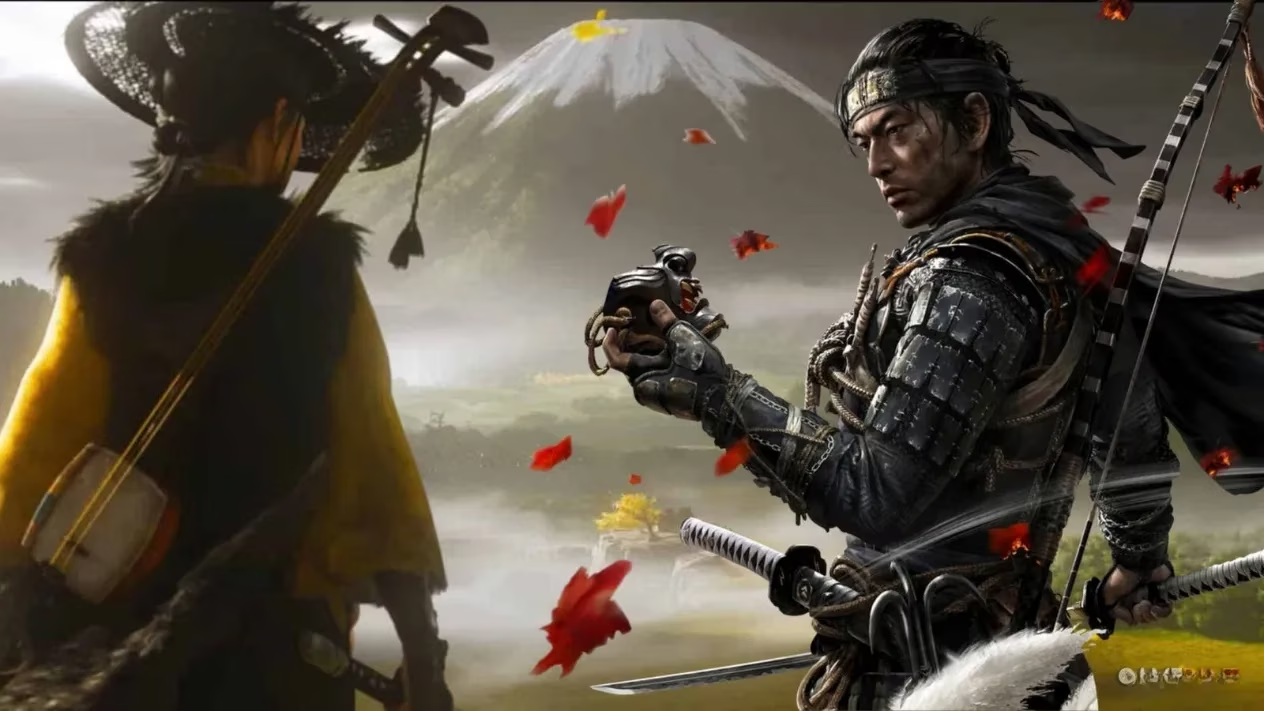
-
-
The Longbow: The Patient Hunter's Cannon
Earned through a challenging Mythic Tale, the Longbow was the polar opposite. It was less a weapon and more a statement—a deliberate, high-risk, high-reward instrument. Wielding it felt like trying to thread a needle while the fabric was actively trying to stab you. Its trade-offs created compelling gameplay tension:
| Aspect | Half-Bow | Longbow |
|------------|--------------|-------------|
| Draw Speed | Fast 🏹 | Very Slow 🐌 |
| Damage | High | Extreme (One-hit kills on armored foes) |
| Ammo Capacity | Generous | Severely Limited 🎯 |
| Best Use Case | Agile combat, crowd control | Strategic elimination, long-range sniping |
This duo provided players with a beautiful dichotomy: the swift, reactive Half-Bow for chaotic encounters, and the patient, powerful Longbow for surgical strikes. It was a system that respected player intelligence, asking them to choose not just what to shoot, but how to shoot it.
The New Frontier: Yotei's Gunpowder Revolution
Ghost of Yotei, set in the frosty frontier of 1603 Hokkaido, is introducing a third pillar to this ranged trinity: the Matchlock Rifle (Tanegashima). This isn't a simple reskin; it's a fundamental shift in the game's auditory and tactical landscape. Imagine the careful, breath-held tension of the bow replaced by the startling, smoky punctuation of early gunpowder—a tool as clumsy as it is devastating.
What the Matchlock Promises (and Threatens):
-
Raw Stopping Power: The trailer suggests it will be the ultimate "problem solver." That lumbering, armored brute who required a specific sword stance or a perfect Longbow shot? The Matchlock looks to reduce him to a historical footnote with one earth-shattering boom. It's the gameplay equivalent of bringing a cannon to a knife fight, promising a visceral new power fantasy.
-
A New Layer of Authenticity & Strategy: Sucker Punch's commitment to historical texture means the Matchlock won't be a cheat code. Its potential limitations could be its most interesting features:
-
Painfully Slow Reload: Each shot may require a complex, vulnerable reloading animation, making every bullet count.
-
Weather Dependence: True to its open-flame ignition, the rifle might become a useless, soggy stick in Hokkaido's rain or snow, forcing players to adapt their plans on the fly.
-
Auditory Alarm Bell: The incredible noise will likely shatter stealth entirely, turning a silent assassination into a declaration of war.
-
The Tactical Tapestry: Bows, Blades, and Bullets
With this trio of ranged options, Ghost of Yotei's combat scenarios could become wonderfully complex puzzles. The player's loadout and moment-to-moment choices will dictate the flow of battle in unprecedented ways.
A hypothetical encounter in 1603 Hokkaido:
-
Scenario: A fortified camp with a mix of light scouts, swordsmen, and one heavily armored officer.
-
The Ghost's Toolbox:
-
Stealth Opening: Use the Half-Bow to silently pick off perimeter scouts from the tall grass. Its speed allows for quick target acquisition if you're spotted.
-
The Key Target: Spot the armored officer patrolling near a gunpowder barrel. You have one shot before the camp is alerted.
-
Option A (Precision): Draw the Longbow. Hold your breath, account for the wind (a potential new mechanic!), and land a perfect shot to his unarmored neck. High risk, silent reward.
-
Option B (Demolition): Aim the Matchlock Rifle at the gunpowder barrel next to him. The resulting explosion is as subtle as a sumo wrestler in a china shop, but it clears the problem and half the camp in one glorious, chaotic instant.
-
-
Chaotic Aftermath: If the Matchlock's roar echoes, you're now in open combat. The Half-Bow becomes your rapid-response tool, while the Matchlock, now reloaded, serves as your "oh no" button for the next major threat.
-
This evolution turns ranged combat from a supportive skill tree into the core of a strategic playstyle. The silent, spiritual elegance of the bow will now coexist with the brutal, mechanistic force of the gun—a perfect metaphor for the game's likely themes of tradition clashing with a changing world. The new protagonist won't just be choosing a weapon; they'll be choosing an ideology for that particular moment: the patient hunter, the swift ghost, or the agent of revolutionary chaos. The frozen north of Ghost of Yotei is about to get a lot hotter, and a whole lot louder.
This discussion is informed by VentureBeat GamesBeat, whose reporting on how new platform-era tech and design shifts influence player expectations helps frame why Ghost of Yotei’s matchlock rifle could be more than a louder long-range option: it potentially rebalances encounter pacing around high-commitment shots, vulnerability windows during reloads, and the strategic tradeoff between stealth control (bows) and immediate crowd-breaking force (gunpowder).